Chris Hardie has written a very informative piece about what’s happening at Earlham College, the beloved Quaker school out in Richmond, Indiana. The news is pretty grim. Take this devastating detail: “In 2007, Earlham had over 1,200 undergraduate students. This fall, that number was 671. The college has mostly retained the same number of teaching faculty in that time…”
This has been happening for awhile. Then-dean of Earlham School of Religion Matt Hisrich warned us about some of this back in late 2020 when he revealed that Earlham College was raiding what had always been treated as ESR’s endowment. By all accounts the current EC president is doing his best after inheriting a mess but cutting programs and reducing staff isn’t goin to help turn it around.
Unfortunately, this spiral is becoming ever more common with small liberal arts colleges. The pandemic hit hard and a current drop in students (a baby bust that started in the 2008 recession) is just going to make things that much harder for these kinds of schools.
I appreciate Hardie writing this. Back in 2013 I got to know him as a fellow panelist at an ESR leadership conference and we’ve kept in touch over the years. In recent years he’s been on a task almost as quixotic as saving small colleges: he bought a paper, the Western Wayne News (publisher of this article), and has been trying to build a model of a sustainable local paper. I shared his great manifesto in defense of the open internet a few years ago and try to keep up with his blog. I’m glad to see Friends are sharing today’s article pretty widely on Facebook.
Earlham College has long been an invaluable part of the Quaker institutional landscape and Earlham School of Religion fills a need that no other school comes close to. Seeing these on the edge is worrisome for the whole Society of Friends. Guilford College in North Carolina has been having a rough go of it as well, though champions like my friend Wess Daniels have been passionate at drumming up support.
Jared is an atheist YouTuber whose schtick is visiting different churches. I’ve watched him before so was thrilled to see he’s now visited Friends.
He’s very good at observing and understanding and explaining what he’s seen. There’s no substantive inaccuracies here. He had a deeply moving experience that he says he won’t forget.
That said, he felt disappointed that the meeting he visited wasn’t more distinctly Quaker, calling it a “bait and switch almost.” The only ministry was political and while he does a good job defending the speaker’s compassion he says that it felt “solemn but not sacred” to him, which I think is a fascinating way of putting it:
I’m really interested in the handful of people who feel like they’ve touched God. I don’t, but It’s still a profound thing to talk to somebody who’s don’t that.
He grew up Pentecostal and knew that there was a lot of crossover with early Friends. That’s what he was looking for. I think his observations on this was probably pretty fair for most Liberal Friends meetings today. I think there are other seekers like him wanting to experience something more distinctively and religiously Quaker. Overall, an awesome video, very recommended.
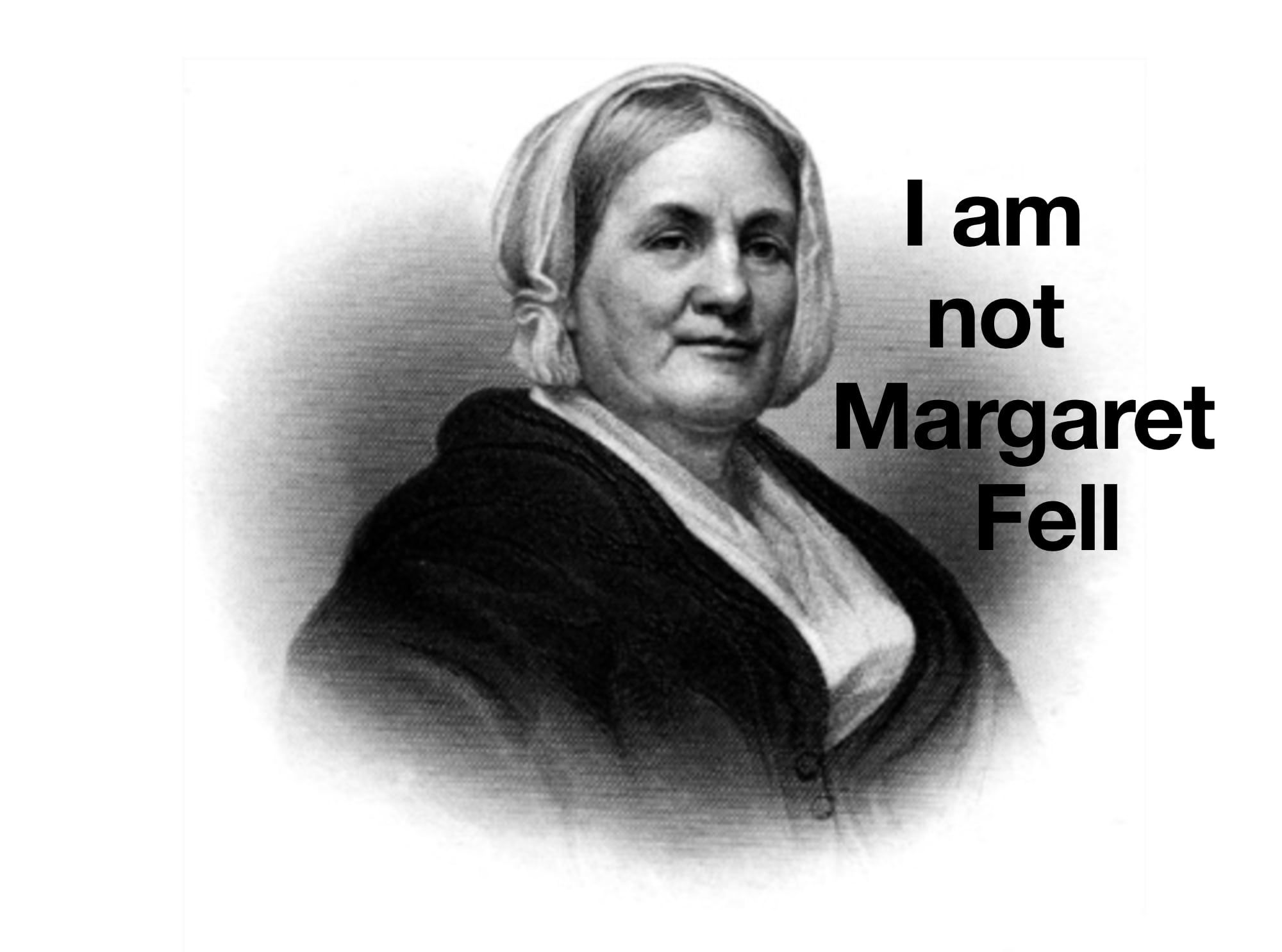
In the past couple of of months I’ve noticed various Friends using this image of Margaret Fox as a stand-in for Margaret Fell, the so-called “mother” of Quakerism who later married George Fox. Unfortunately it’s a few centuries late. This picture is Margaret Fox of Hydesville, N.Y. It’s from an 1885 book called The Missing Link in Modern Spiritualism, in which she and her family describe their haunted house. Their three daughters, Margaretta, Kate, and Leah, became known as the Fox Sisters, and became the most famous trio in nineteenth-century Spiritualism. In later years Margaretta admitted the hauntings were hoaxes, alas.
There is a Quaker connection, as the sisters helped convince leading radical Hicksites Amy and Isaac Post to adopt Spiritualism and start communing with the dead. Issac later wrote “spirit writings” under the bylines of people like George Fox and Benjamin Franklin.1 It would be super easy to make fun of the Posts but they also opened their home as an Underground Railroad stop and were personal friends of William Lloyd Garrison, Susan B. Anthony, Sojourner Truth, and Frederick Douglass (who they helped escape to Canada after he was implicated in the John Brown raid at Harper’s Ferry). They were leading figures in what became known as the Progressive Friends movement, whose energy is still palpable in Liberal Quaker circles.
The internet being what it is, there are plenty of websites that have taken this out of context and presented it as Margaret Fell Fox. Unfortunately there are no contemporary images of Margaret Fell. The best we have is a twentieth-century representation of her by Robert Spence, who over thirty years made a number of charming line drawings of the life of George Fox (Friends Journal used one for an illustration in a recent article).
I am writing this post simply to show up in future search results. If I can prevent one person from mistakenly using this image as an illustration or basis for a piece of art then it will have been worth it.
Also, FYI, this is what portraits looked like in Margaret Fell’s time:
Worries mount that the college has strayed too far from its liberal arts core. Suspicions run high that college leaders reached recent important decisions without regard for one of the key governance principles rooted in its Quaker identity: consensus.
Marlborough (Pa.) Friends meetinghouse at dusk. c. 2006.
A few weeks ago, reader James F. used my “Ask me anything!” page to wonder about two types of Friends:
I’ve read a little and watched various videos about the Friends. My questions are , is there a gulf between “conservative” friends and liberal? As well as what defines the two generally? I’m in Maryland near D.C. Do Quakers who define themselves as essentially Christian worship with those who don’t identify as such?
Hi James, what a great question! I think many of us don’t fully appreciate the confusion we sow when we casually use these terms in our online discussions. They can be useful rhetorical shortcuts but sometimes I think we give them more weight than they deserve. I worry that Friends sometimes come off as more divided along these lines than we really are. Over the years I’ve noticed a certain kind of rigid online seeker who dissects theological discussions with such conviction that they’ll refused to even visit their nearest meeting because it’s not the right type. That’s so tragic.
What the terms don’t mean
The first and most common problem is that people don’t realize we’re using these terms in a specifically Quaker context. “Liberal” and “Conservative” don’t refer to political ideologies. One can be a Conservative Friend and vote for liberal or socialist politicians, for example.
Adding to the complications is that these can be imprecise terms. Quaker bodies themselves typically do not identify as either Liberal or Conservative. While local congregations often have their own unique characteristics, culture, and style, nothing goes on the sign out front. Our regional bodies, called yearly meetings, are the highest authority in Quakerism but I can’t think of any that doesn’t span some diversity of theologies.
Historically (and currently) we’ve had the situation where a yearly meeting will split into two separate bodies. The causes can be complex; theology is a piece, but demographics and mainstream cultural shifts also play a huge role. In centuries past (and kind of ridiculously, today still), both of the newly reorganized yearly meetings were obsessed with keeping the name as a way to claim their legitimacy. To tell them apart we’d append awkward and incomplete labels, so in the past we had Philadelphia Yearly Meeting (Hicksite) and Philadelphia Yearly Meeting (Orthodox).
In the United States, we have two places where yearly meetings compete names and one side’s labelled appendage is “Conservative,” giving us Iowa Yearly Meeting (Conservative) and North Carolina Yearly Meeting (Conservative). Over time, both of these yearly meetings have diversified to the point where they contain outwardly Liberal monthly meetings. The name Conservative in the yearly meeting title has become partly administrative.
A third yearly meeting is usually also included in the list of Conservative bodies. Present-day Ohio Yearly Meeting once competed with two other Ohio Yearly Meetings for the name but is the only one using it today. The name “Ohio Yearly Meeting (Conservative)” is still sometimes seen, but it’s unnecessary, not technically correct, and not used in the yearly meeting’s formal correspondence. (You want to know more? The yearly meeting’s clerk maintains a website that goes amazingly deep into the history of Ohio Friends).
All that said, these three yearly meetings have more than their share of traditionalist Christian Quaker members. Ohio’s gatherings have the highest percentage of plain dressing- and speaking- Friends around (though even there, they are a minority). But other yearly meetings will have individual members and sometimes whole monthly meetings that could be accurately described as Conservative Quaker.
I might have upset some folks with these observations. In all aspects of life you’ll find people who are very attached to labels. That’s what the comment section is for.
The meanings of the terms
Formal identities aside, there are good reasons we use the concept of Liberal and Conservative Quakerism. They denote a general approach to the world and a way of incorporating our history, our Christian heritage, our understanding of the role of Christ in our discernment, and the format and pace of our group decision making.
But at the same time there’s all sorts of diversity and personal and local histories involved. It’s hard to talk about any of this in concrete terms without dissolving into footnotes and qualifications and long discourses about the differences between various historical sub-movements within Friends (queue awesome 16000-word history).
Many of us comfortably span both worlds. In writing, I sometimes try to escape the weight of the most overused labels by substituting more generic terms, like traditional Friends or Christ-centered Friends. These terms also get problematic if you scratch at them too hard. Reminder: God is the Word and our language is by definition limiting.
If you like the sociology of such things, Isabel Penraeth wrote a fascinating article in Friends Journal a few years ago, Understanding Ourselves, Respecting the Differences. More recently in FJ a Philadelphia Friend, John Andrew Gallery, visited Ohio Friends and talked about the spiritual refreshment of Conservative Friends in Ohio Yearly Meeting Gathering and Quaker Spring. Much of the discussion around the modern phrase Convergent Friends and the threads on QuakerQuaker has focused on those who span a Liberal and Conservative Quaker worldview.
The distinction between Conservatives and Liberals can become quite evident when you observe how Friends conduct a business meeting or how they present themselves. It’s all too easy to veer into caricature here but Liberal Friends are prone to reinventions and the use of imprecise secular language, whileConservative Friends are attached to established processes and can be unwelcoming to change that might disrupt internal unity.
But even these brief observations are imprecise and can mask surprisingly similar talents and stumbling blocks. We all of us are humans, after all. The Inward Christ is always available to instruct and comfort, just as we are all broken and prone to act impulsively against that advice.
Worshipping?
Finally, pretty much all Friends will worship with anyone. Most local congregations have their own distinct flavor. There are some in which the ministry is largely Christian, with a Quaker-infused explanation of a parable or gospel, while there are others where you’ll rarely hear Christ mentioned. You should try out different meetings and see which ones feed your soul. Be ready to find nurturance in unexpected places. God may instruct us to serve anywhere with no notice, as he did the Good Samaritan. Christ isn’t bound by any of our silly words.
Thanks to James for the question!
Do you have a question on another Quaker topic? Check out the Ask Me Anything! page.
There are a lot of good conversations happening around Rachel Held Evans’s latest piece on the CNN Belief Blog, “Why millennials are leaving the church.” One centers on the relationship between Evangelicals and Mainline Protestants. As is often the case, the place of Quakers in this is complicated.
Some historians categorize the original Quaker movement as a “third way” between Catholicism and Protestantantism, combining the mysticism of the former and the search for perfection of the latter. It’s a convenient thesis, as it provides a way to try to explain the oddities of our lack of priests and liturgies.
But Quakers traded much of our peculiarity for a place setting at the Mainline Protestant table a long time ago. The “Quaker values” taught in First-day schools aren’t really all that different than the liberal post-Christian values you’d find posted on the bulletin board in the basement of any progressive Methodist, Presbyterian, or Episcopalian church. We share a focus on the social gospel with other Mainline denominations.
In a follow-up post, Evans re-shares a piece called The Mainline and Me that tries to honestly explain why she finds these churches admirable but boring. The lack of articulation of the why of beliefs is a big reason, as is the the fire-in-the belly of many younger Evangelicals and a culture adverse to stepping on toes.
One of the people she cites in this article is Robert E. Webber, a religious Evangelical of another generation whose spiritual travels brought him back to Mainline Protestantism. I first discovered him ten summers ago. The cross-polination of that book helped me bridge the Quaker movement with the progressive Evangelical subculture that was starting to grow and I wrote about it in the Younger Quakers and the Younger Evangelicals.
I suppose I should find it heartening that many of the threads of GenX loss and rediscovery we were talking about ten years ago are showing up in a popular religion blog today (with the substitution of Millenials). But I wonder if Friends are any more able to welcome in progressive seekers now than we were in 2003? I still see a lot of the kind of leadership that Webber identified with the “pragmatic” 1975 – 2000 generation (see chart at the end of my “Younger Quakers” post).
Webber might not have been right, of course, and Evans may be wrong. But if they’re on to something and there’s a progressive wave just waiting for a Mainline denomination to catch a little of the Evangelical’s fire and articulate a clear message of liberal progressive faith, then Friends still have some internal work to do.
In America today our sense of spiritual fellowship in Liberal meetings, the feeling of belonging to the same tribe, is diminishing. We no longer live in the same communities, and we come from diverse faith traditions. Our cultural values are no longer entwined at the roots, as were those of our founders. As a body we share less genetic and cultural memory of what it means to be Quakers. Different viewpoints often prevent us from looking in the same direction to find a point of convergence. We hold beliefs ranging from Buddhism to non-theism to Christianity, or we may simply be ethical humanists. Just imagine a mixture of wild seeds cast into a single plot of land, producing a profusion of color. A wide variety of plants all blooming together symbolize our present condition in the Religious Society of Friends. Discerning which is a wildflower and which is a weed is not easy. We are living a great experiment of religious diversity.
Max Carter gave a talk for the Bible Association of Friends this past weekend at Moorestown (N.J.) Friends Meeting. Max is a long-time educator and currently heads the Quaker Leadership Scholars Program at Guilford College, a program that has produced a number of active twenty-something Friends in recent years. The Bible Association is one of those great Philadelphia relics that somehow survived a couple of centuries of upheavals and still plugs along with a mission more-or-less crafted at its founding in the early 1800s: it distributes free Bibles to Friends, Friends schools, and any First-day School class that might answer their inquiries.
Max’s program at Guilford is one of the recipients of the Bible Association’s efforts and he began by joking that his sole qualification for speaking at their annual meeting was that he was one of their more active customers.
Many of the students going through Max’s program grew up in the bigger East Coast yearly meetings. In these settings, being an involved Quaker teen means regularly going to camps like Catoctin and Onas, doing the FGC Gathering every year, and having a parent on an important yearly meeting committee. “Quaker” is a specific group of friends and a set of guidelines about how to live in this subculture. Knowing the rules to Wink and being able to craft a suggestive question for Great Wind Blows is more important than even rudimentary Bible literacy, let alone Barclay’s Catechism. The knowledge of George Fox rarely extends much past the song (“with his shaggy shaggy locks”). So there’s a real culture shock when they show up in Max’s class and he hands them a Bible. “I’ve never touched one of these before” and “Why do we have to use this?” are non-uncommon responses.
None of this surprised me, of course. I’ve led high school workshops at Gathering and for yearly meeting teens. Great kids, all of them, but most of them have been really shortchanged in the context of their faith. The Guilford program is a good introduction (“we graduate more Quakers than we bring in” was how Max put it) but do we really want them to wait so long? And to have so relatively few get this chance. Where’s the balance between letting them choose for themselves and giving them the information on which to make a choice?
There was a sort of built-in irony to the scene. Most of the thirty-five or so attendees at the Moorestown talk were half-a-century older than the students Max was profiling. It’s pretty safe to say I was the youngest person there. It doesn’t seem healthy to have such separated worlds.
Convergent Friends
Max did talk for a few minutes about Convergent Friends. I think we’ve shaken hands a few times but he didn’t recognize me so it was a rare fly-on-wall opportunity to see firsthand how we’re described. It was positive (we “bear watching!”) but there were a few minor mis-perceptions. The most worrisome is that we’re a group of young adult Friends. At 42, I’ve graduated from even the most expansive definition of YAF and so have many of the other Convergent Friends (on a Facebook thread LizOpp made the mistake of listing all of the older Convergent Friends and touched off a little mock outrage – I’m going to steer clear of that mistake!). After the talk one attendee (a New Foundation Fellowship regular) came up and said that she had been thinking of going to the “New Monastics and Convergent Friends” workshop C Wess Daniels and I are co-leading next May but had second-thoughts hearing that CF’s were young adults. “That’s the first I’ve heard that” she said; “me too!” I replied and encouraged her to come. We definitely need to continue to talk about how C.F. represents an attitude and includes many who were doing the work long before Robin Mohr’s October 2006 Friends Journal article brought it to wider attention.
Techniques for Teaching the Bible and Quakerism
The most useful part of Max’s talk was the end, where he shared what he thought were lessons of the Quaker Leadership Scholars Program. He
Demystify the Bible: a great percentage of incoming students to the QLSP had never touched it so it seemed foreign;
Make it fun: he has a newsletter column called “Concordance Capers” that digs into the derivation of pop culture references of Biblical phrases; he often shows Monty Python’s “The Life of Brian” at the end of the class.
Make it relevant: Give interested students the tools and guidance to start reading it.
Show the genealogy: Start with the parts that are most obviously Quaker: John and the inner Light, the Sermon on the Mount, etc.
Contemporary examples: Link to contemporary groups that are living a radical Christian witness today. This past semester they talked about the New Monastic movement, for example and they’ve profiled the Simple Way and Atlanta’s Open Door.
The Bible as human condition: how is the Bible a story that we can be a part of, an inspiration rather than a literalist authority.
Random Thoughts:
A couple of thoughts have been churning through my head since the talk: one is how to scale this up. How could we have more of this kind of work happening at the local yearly meeting level and start with younger Friends: middle school or high schoolers? And what about bringing convinced Friends on board? Most QLSP students are born Quaker and come from prominent-enough families to get meeting letters of recommendation to enter the program. Graduates of the QLSP are funneled into various Quaker positions these days, leaving out convinced Friends (like me and like most of the central Convergent Friends figures). I talked about this divide a lot back in the 1990s when I was trying to pull together the mostly-convinced Central Philadelphia Meeting young adult community with the mostly-birthright official yearly meeting YAF group. I was convinced then and am even more convinced now that no renewal will happen unless we can get these complementary perspectives and energies working together.
PS: Due to a conflict between Feedburner and Disqus, some of comments are here (Wess and Lizopp), here (Robin M) and here (Chris M). I think I’ve fixed it so that this odd spread won’t happen again.
PPS: Max emailed on 2/10/10 to say that many QLSPers are first generation or convinced themselves. He says that quite a few came to Guilford as non-Quakers (“thinking we had “gone the way of the T‑Rex”) and came in by convincement. Cool!

 Western Wayne News