I interview John Helding on the Quaker Talk podcast about “worship fluid” Quakerism.
The new issue of Friends Journal is up. I wrote the Among Friends intro this month, waxing lyrically on the “sonic landscape” of my meeting in August:
The sounds of our August silence are far from pure. Although the calls of red-shouldered hawks can be a bit harsh, hearing them reminds me that a family shares the trees of our burial ground. The crunch of the gravel in the driveway reassures me that one of our perpetual late-comers is about to join our fellowship. Not all the sounds are natural, of course. Once or twice in the hour someone will redline a motorcycle on the street outside, the whiny revs and gear changes drifting over to bounce inside our worship space. I usually try to tune out this sound, but sometimes I smile instead, knowing that someone is having fun on a hot summer day. I say a little prayer for their safety and wish them well.
I’ve also recorded a new episode of my author video podcast with John Helding, who wrote How Can I Keep from Singing? The Marvelous Mystery of Worship-Fluid Meetings. He tells a great story of going from a very died-in-the wool unprogrammed meeting to Lopez Island Worship Group (now full Quaker meeting) that scheduled monthly singing worship and worship sharing. I think I’m always going to prefer the model of sitting down quietly and waiting for the Holy Spirit but I do appreciate that it’s hard to build up a meeting culture that invites ministry. I’m happy that the worship sharing at Lopez Island helped uncork nascent ministry in the standard, open worship.
As I wrote a few years ago, I think ministry should be an expected miracle and not have quite so high a bar that people are intimidated from speaking. It takes practice to know when ministry is Spirit-led and maybe part of that practice is not always getting it right. I know some meetings face the opposite problem: ministry that is perhaps too frequent and too headstrong and inappropriate. But a Friends Meeting is a bit like a choir in that it is always needing creative renegotiation to find the sweet harmony. We are a chosen family that just shows up every week, with people experienced and new working and learning how to hold the body together.
I encourage Friends to please remember that Generative AI art is produced unethically from AI models that scrape the work of real artists without consent or compensation. In the last few weeks, I have encountered two instances of Quakers using Generative AI as a part of their Outreach. This is deeply disturbing to me. There is no legitimate reason to use Generative AI Art. You can use open source images, you can hire artists, or you can make your own art. Or, use no art at all. Better that than to steal from artists and display art you hand no hand in making.
My Facebook feed is awash in terrible AI art accompanied by terrible AI-written feel-good stories, shared as much by Quakers as by any other demographic (my bad for still being on there, perhaps).
Quakerism is a spirituality that requires active participation. You can’t just nod off in the back (well, you can but you shouldn’t). Quaker communities have been lived experiences. As someone who works daily with writers, it’s stunning just how much AI has become a crutch for people. There are some very active writers in Quaker online spaces whose work is mostly AI. Is it for the social boost that comes from being ubiquitous?
A weird tangent but hear me out: if you read a lot of classic Quaker journals, there’s frequently stories from their teens in which the author consciously wrestles with plain dress. They talk about the lost friendships that came when they adopted a more uniform style and also about how hard it is to discern and navigate the inevitable voice of pride inside themselves (look at me, I’m plain!) with their legitimate wish and leading to be of use to the fellowship. That process of wrestling with ego is something that never ends for any of us, but especially not one of these ministers. Knowing when ministry is Spirit-led or ego-fed is a core competency for this work. In the end, the dress didn’t matter so much. But the “baby steps” of worrying about it was an early workout of those discernment muscles.
When we turn to AI we stop working those muscles and offload so much to the machine. Skipping the baby steps means we’re not necessarily going to be as practiced when important decisions need to be made. Let’s put out bad art if it means we’ll start learning how to put out more authentic art as we develop.
I suppose that in either case, Christian or Quaker, the prevailing assumption was that these books are for internal use among Friends. This is who we are, more or less. But what I like about the title Christian Faith and Practice is another interpretation entirely, one I have no permission or evidence to propose: this way of faith and life is not just for us; it’s recommended for all Christians.
I’d argue a strong yes to this. When I think about what ancient Quaker oddities might still be relevant, one of the questions I ask myself is whether we could argue that the whole church should also adopt the practice (however unlikely that might be in reality). If it’s just some Quaker canard, we can toss it into an antiquity dustbin. But if all Christians should be following the practice, then let’s set the example.
I like Thomas Clarkson’s historical account of Friends particularly because he’s not writing for a Quaker audience. I get the feeling he’s holding our practices up for scrutiny, as if to say that maybe everyone should be following them and indeed, his pacifism and abolitionism were greatly influenced by the Friends he met in his work.
Of course this witness to other Christians sort of falls apart if we don’t consider ourselves Christian. If online discourse is any indication, there are large numbers of Quakers who are rather oblivious that almost all of our Quaker identity has a biblical basis (selective, of course, and also interpreted, debated and changing). Quakerism is seen as something that just randomly popped up in the world. None of the early Friends would have thought that.
If you ask about Quaker beliefs these days, one of the common answers you’ll get is SPICE, a handy acronym that holds together a hodgepodge of values, namely: simplicity, peace, integrity, community and equality (and later sustainability to become SPICES). One Quaker school definitively puts it, “Quakers agree to a core set of values, known as testimonies.” I’ve not found SPICES listed before 2000 and even many of the individual components are absent from older books of Faith and Practice.
The question of where this ubiquitous acronym came from, and when, regularly comes up in Quaker discourse (mostly recently on Reddit here). I sometimes answer with the bits I’ve dug up but rather than reinventing the wheel each time, I thought I’d write it all down. I invite people to add what they know in comments and I’ll edit this.
1940s
Howard Brinton was the inventor of our modern idea of a “testimony” in the 1940s, and his original list was community, harmony, equality, and simplicity. He was the Philadelphia-area born Friend who helped organize unprogrammed Friends on the U.S. West Coast in the early part of the twentieth century. Brinton had a knack for simple explanations that expressed the emerging consensus of a new generation of Friends who were healing from the nineteenth-century schisms. Finding new ways of talking about our commonalities was a central part of the work of reconciliation. From his tour de force 1952 masterpiece, Friends for 300 Years:
The meaning of the group in Quaker practice can be suggested by a diagram. Light from God streams down into the waiting group. This Light, if the way is open for it, produces three results: unity, knowledge, and power. As a result we have the kind of behavior which exists as an ideal in a meeting for worship and a meeting for business. Because of the characteristics of the Light of Christ, the resulting behavior can be described in a general way by the four words Community, Harmony, Equality, and Simplicity.…
He included a chart, which honestly doesn’t help much with my understanding of the metaphysics of it all.
1975
Reader Tomas Mario Kalmar sent me a paper called Learning Community prepared by the Education Commission of Australian Yearly Meeting that lists six “characteristics that distinguished Quaker education”: a religiously guarded education, community, non-violence, equality, simplicity, and an experiential curriculum. The list is largely based on Howard Brinton’s work but I include it here because it shows how Friends were remixing and repurposing his list. Learning Community actually looks pretty good and fairly timeless and Tomas gave me permission to repost the PDF here.
1980 – 90s
In a Reddit thread a few years ago, macoafi wrote: “My in-laws were children in first day school in the 1980s and 1990s, and they learned 4 testimonies, no acronym. (Peace, truth, simplicity, equality).” At some point Brinton’s harmony started being called peace so this is mostly his list except for truth being swapped for community.
1981
Commenter Sharon writes:
I first heard SPICE at the 1981 FGC gathering in Berea KY! At the time it didn’t sit well with me as I found it too glib. I was still working out what God wanted my life to testify too.
This would put it nearly two decades before from any documented instance I’ve seen. It is also well before any instance I’ve seen that included an I for integrity. I admit I’ll remain skeptical until I see further evidence, though it is possible that someone remembered it from the Berea gathering and started reusing it in the last 1990s.1
1990
Wilmer Cooper was an Ohio Wilburite Friend who went on to become first dean of Earlham School of Religion upon its founding in 1960. Thirty years later he published A Living Faith, which was built on an ESR course called Basic Quaker Beliefs. In the preface he writes: “It is my hope that this work will help Friends gain a fuller understanding of their Quaker heritage and theological roots, while providing for non-Quakers a comprehensive answer to the questions: ‘Who are the Quakers?’ and “What is Quakerism?’ ” In its final chapter Cooper has two lists, which each have four testimonies. His religious testimonies are:
belief that we can have direct and immediate access to the living God;
we can no only know the will of God but can, by God’s grace, be enabled to do the will of God.
the Quaker experience of of community as expressed in the “gathered meeting.”
the sacramental view of life.
His social testimonies are:
Peace Testimony
simplicity
equality
integrity
He expands to give a paragraph to each of his eight testimonies but obviously the second list is much pithier.2. He does say that this isn’t a canonical list, that different Friends will have different lists, and concludes the section on testimonies by, well, testifying: “Friends believe deeply that if they submit themselves to God and live by the Light of Christ they will be enabled to live by the truth of the Gospel.” It’s worth noting that the later SPICE/S formulation didn’t include any of the religious ones (you could perhaps try to claim community dervices from his religious testimonies list but I don’t generally hear the SPICES C described in the kind of spiritual language Cooper used).
The next year Cooper wrote a Pendle Hill pamphlet that focused on integrity. As far as I’ve seen Cooper is the first to include an I for integrity, setting the stage for our familiar acronym.
Mid-1990s
My wife Julie insists that she remembers talk of SPICE/S back when she was in high school starting to get involved with Friends (circa 1994). She didn’t attend a Quaker school so this would have been in Philadelphia Yearly Meeting circles, probably specifically South Jersey.
Late 1990s
In a comment to this very post, Pendle Hill editor Janaki Spickard Keeler says that when she was working a 2023 pamphlet with Paul Buckley, they tracked SPICE/S to a Friends Council for Education listserv for educators (perhaps E‑Quakes, which was started in 1996 according to a FCE history). Janaki writes: “No one came forward as being the first to come up with the idea, but they shared it along themselves and it spread. They estimate this happened around 1998.” The pamphlet quotes Tom Hoopes, who started as director of education for Philadelphia Yearly Meeting in 1998: “I encountered it in use by one of the monthly meetings of Philadelphia Yearly Meeting, and I thought to myself, ‘what a great mnemonic device for helping people to remember what we Quakers claim to prioritize, and to try to practice!’” Tom told Janaki and Paul that he didn’t remember the identity of the Friends meeting.
1999
The Summer 1999 edition of Salem Quarter (N.J.) News reports that Woodstown Meeting created a SPICE rap in for a First-day School program which also included songs from Spice Girls. Yes it’s as unique as it sounds:
What’s the word? SPICE!!!! What’s the word? SPICE IS THE WAY TO GO!!!! Simplicity is simple, and you know it’s right. Squanderin’ money gets ya into a fight. Peace, it rules, and you know that it’s true. It’s the thing I need to get along with you. Don’t yell and sing those fightin’ songs, when you can help others and right their wrongs. Integrity is always bein’ true to your word. It’s the most honest testimony I’ve ever heard. Livin’ and a‑sharin’ all together’s really fun. Community is helpin’, workin’, playin’ all in one. Equality means everyone is equal, and that’s cool. Respecting other is what’s right and is the golden rule!!
Note that the article gives a clue on source: “After reading a short article in Philadelphia Yearly Meeting News with the acronym SPICE highlighting the testimonies… [we] were inspired to incorporate this into our First Day School Program at Woodstown MM.” The oldest copy of PYM News available via Archive.org is tantalizingly close — Nov/December 1999. That seems to be when PYM started posting its newsletter.3
I myself first complained about SPICE in 2004 (note it hadn’t gotten a second S yet). I complained that this kind of list of secular testimonies were too restrictive. I really was a Quaker Ranter back then; also I was really kind of hard on Brinton, who I appreciate more now.
2006
I like to search the Friends Journal archives to see when new terms show up. New terms are often bandied about by particular Friends or within sub-groups, where they might circulate for a few years without getting into wider usage. As far as I’ve been able to determine, the first reference to SPICES in Friends Journal is a 2006 article by Harriett Heath titled “The Quaker Parenting Project: A Report.” She’s lays it out as an attempt to teach Quaker children without resorting to dogma:
There are several different lists of testimonies. We started with one commonly referred to by the acronym SPICES: Simplicity, Peace, Integrity, Community, Equality, and Stewardship — but we found that there were other issues not addressed by this list. Service is an integral part of Quakerism in our efforts to live our faith; should it be a testimony? Education has been historically an integral part of Quakersim; should it, too, be included? Where does worship — time set apart — fit in?
Her project eventually picked a different list because they didn’t want to be bound by the dictates of fitting into an acronym. They included conflict and growth and service (which sometimes is listed as the final S).
2007/2008 videos
In 2007, British Friends could produce a video called “The Quaker Testimonies” that didn’t mention SPICE/S and ranged over other non-acronymed testimonies such as one for respect and another against oath-taking. If you listen carefully, I think at least one of the speakers must have heard of SPICE because he seemed to be organizing thoughts around it.
Brinton scholar Anthony Manousos did a deep dive on SPICES. Although Anthony claims Briton invented SPICES per se, I think he just invented the idea of testimonies and the initial list that included three of them (four if you count the harmony/peace change).
2011
Less than two years after Heath’s article, Mark Dansereau and Kim Tsocanos, the co-heads of Connecticut Friends School in Wilton, Conn., published an annotated list of SPICES in Friends Journal, explaining that their school was built on these “Six Quaker Values” (yes, italicized and capitalized) and that they applied and wove them into each activity in their curricula. This might be one of the oldest fully-intact listings still easily available on the web. This has become one of the most visited pages on Friends Journal website.
Paul Buckley gave a talk in 2012 that highlighted the role of Wilmer Cooper, an Ohio Friend perhaps most well remembered for founding Earlham School of Religion in 1960. In 2023, Paul Buckley wrote a pamphlet from Pendle Hill, Quaker Testimony: What We Witness to the World, edited by Janaki Spickard Keeler, during which they determined the late 1990s date.
2013
Someone around 2006 I was standing in a meal line at a Quaker event with California Friend Eric Moon and we started to talk about testimonies. It was the start of a great conversation, cut short by some interruption or another before we even hit the dessert station. When I started as FriendsJournal editor I asked him to write something. 2013’s Categorically Not the Testimonies was the result. We also talked in an early Quaker Author Podcast.
So where did the SPICES formulation come from? It ultimately derived from Brinton’s list, with harmony morphing to peace and WIl Cooper’s integrity adding an I. Given its pedagogical nature, it was probably coined by educators. It’s a good teaching tool, easy to remember and something you can easily weave into a multi-week class.
Since there’s nothing particularly religious about the SPICE/S list, it can work in an essentially secular environment that might be allergic to religious-sounding Quaker theology. This would include Friends schools appealing to a non-Quaker audience or a Liberal Friends Meeting that wants something non-controversial to teach the kids. I never hear anyone talk about it being derived from “characteristics of the Light of Christ,” as Brinton did when he introduced it.
In the last few years it’s become pretty ubiquitous on TikTok and other short-form video (Discovering Quakers, _gloyoyo_, itsmekatevee).4 If you have five minutes to tell a general audience about Quakers, bite-sized descriptions are important. Also: some of these content creators are probably younger than the term itself. Also: I’ve finally grown into the Old Man Yelling at the Clouds meme. SPICES is here to stay.
Is SPICES all that terrible? No, not really. It can be handy. But it is pretty annoying that we’ve confused a list of generic values for belief. And it’s super annoying that even that list of values is hemmed in by the requirement that every component fit into a silly acronym.5
What’s funny about the mystery of this is that there’s a very good chance that the person who first listed out SPICE is still around. There’s a box in someone’s garage packed with late-1990s newsletters, one of which lists it out for the first time in print. Anyone with any information can comment below or email me at martink@martinkelley.com.
I wrote the introductory column for the June/July issue of Friends Journal, which is devoted to revivals.
It’s my pet theory that Quakerism is always dying and simultaneously always being reborn. It’s been a messy process with lots of hurt feelings. Many people have left Friends, and there are a bewildering number of institutional schisms still dividing us. But to paraphrase Mark Twain, the rumors of our death have been greatly exaggerated.
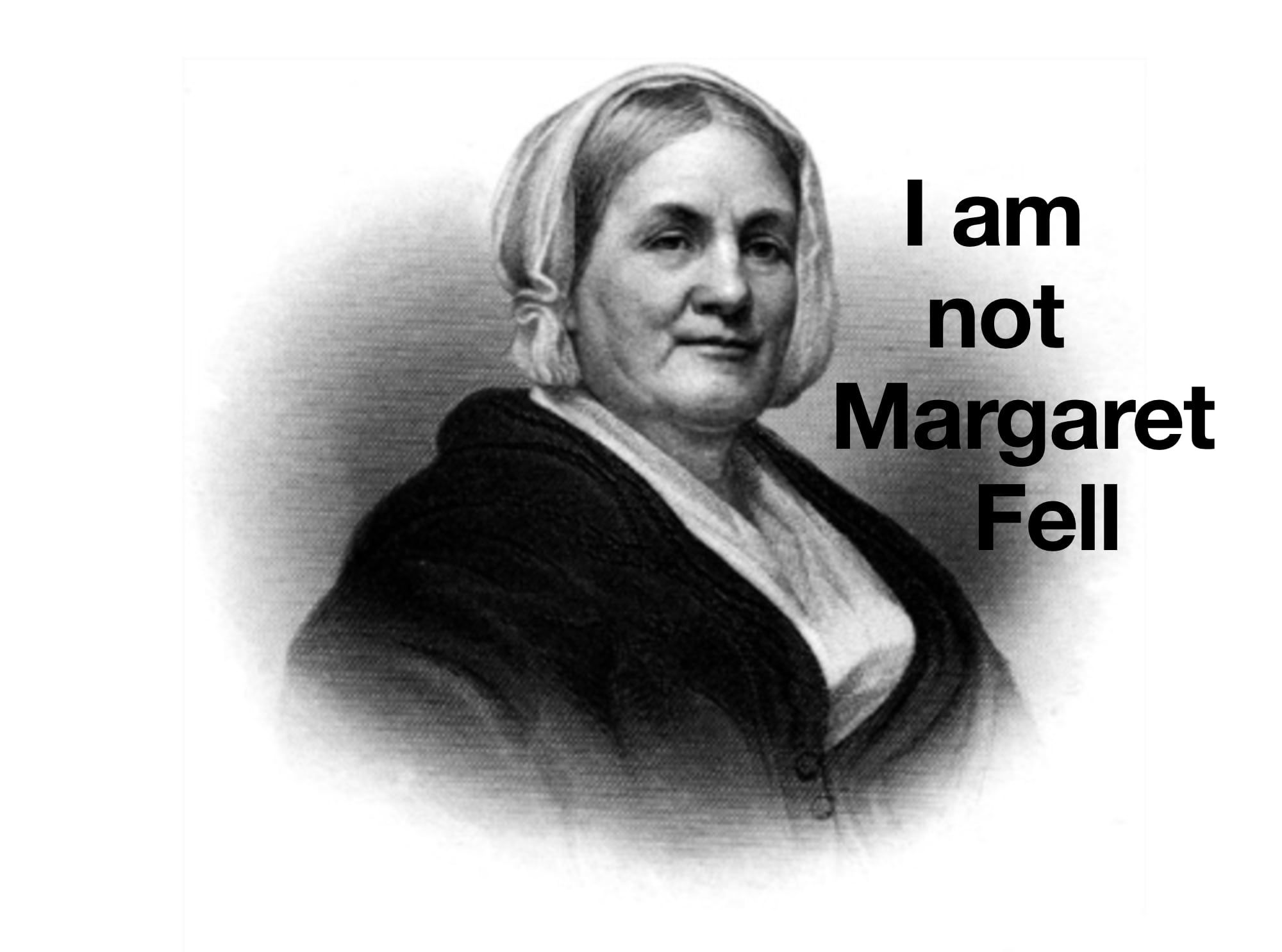
In the past couple of of months I’ve noticed various Friends using this image of Margaret Fox as a stand-in for Margaret Fell, the so-called “mother” of Quakerism who later married George Fox. Unfortunately it’s a few centuries late. This picture is Margaret Fox of Hydesville, N.Y. It’s from an 1885 book called The Missing Link in Modern Spiritualism, in which she and her family describe their haunted house. Their three daughters, Margaretta, Kate, and Leah, became known as the Fox Sisters, and became the most famous trio in nineteenth-century Spiritualism. In later years Margaretta admitted the hauntings were hoaxes, alas.
There is a Quaker connection, as the sisters helped convince leading radical Hicksites Amy and Isaac Post to adopt Spiritualism and start communing with the dead. Issac later wrote “spirit writings” under the bylines of people like George Fox and Benjamin Franklin.6 It would be super easy to make fun of the Posts but they also opened their home as an Underground Railroad stop and were personal friends of William Lloyd Garrison, Susan B. Anthony, Sojourner Truth, and Frederick Douglass (who they helped escape to Canada after he was implicated in the John Brown raid at Harper’s Ferry). They were leading figures in what became known as the Progressive Friends movement, whose energy is still palpable in Liberal Quaker circles.
The internet being what it is, there are plenty of websites that have taken this out of context and presented it as Margaret Fell Fox. Unfortunately there are no contemporary images of Margaret Fell. The best we have is a twentieth-century representation of her by Robert Spence, who over thirty years made a number of charming line drawings of the life of George Fox (Friends Journal used one for an illustration in a recent article).
I am writing this post simply to show up in future search results. If I can prevent one person from mistakenly using this image as an illustration or basis for a piece of art then it will have been worth it.
Also, FYI, this is what portraits looked like in Margaret Fell’s time:
High Profiles magazine has published a nice interview with Alastair McIntosh, a Quaker academic, author, and activist. It’s not all about his Quakerism but then it’s nice to see someone using it as a just a piece of their identity. I love seeing our roots laid out in the same sentence as a critique of the Murdoch press, etc.
The North is the part of England to which the radicals retreated under Norman violence, and I suspect that’s part of why the more radical side of England comes out there. Quakerism developed mainly in the north and west of England and I suspect that nonconformity comes out of that radical spirit – which needs to be rekindled, not in ways manipulated by the Murdoch press or the Conservative Party or Ukip but much more in the way that William Blake understood, of connecting with the spirit of the land.
I’d be remiss if I didn’t add that we ran a nice piece by McIntosh in the February issue of Friends Journal. He talked about Thomas Merton, the Catholic monk with Quaker roots. Again, our spirituality in context.
It’s one of those quotes we frequently hear: that George Fox said a minister’s job was “to bring people to Christ, and to leave them there.” But when I go to Google, I only find secondhand references, sandwiched in quote marks but never sourced. It turns up most frequently in the works of British Friend William Pollard, who used it as kind of a catch phrase in his talks on “An Old Fashioned Quakerism” from 1889. Suspiciously missing is any search result from the journal or epistles of Fox himself. It’s possible Pollard has paraphrased something from Fox into a speech-friendly shorthand that Google misses, but it’s also possible it’s one of those passed-down Fox myths like Penn’s sword.
So in modern fashion, I posed the question to the Facebook hive mind. After great discussions, I’m going to call this a half-truth. On the Facebook thread, Allistair Lomax shared a Fox epistle that convinces me the founder of Friends would have agreed with the basic concept:
I’m guessing it is paraphrase of a portion of Fox’s from epistle 308, 1674. Fox wrote “You know the manner of my life, the best part of thirty years since I went forth and forsook all things. I sought not myself. I sought you and his glory that sent me. When I turned you to him that is able to save you, I left you to him.”
Mark Wutka shared quotations from Stephen Grellet and William Williams which have convince me that it describes the “two step dance” of convincement for early Friends:
From Stephen Grellet: “I have endeavoured to lead this people to the Lord and to his Spirit, and there is is safe to leave them.” And this from William Williams: “To persuade people to seek the Lord, and to be faithful to his word, the inspoken words of the heart, is what we ought to do; and then leave them to be directed by the inward feelings of the mind;”
The two-step image comes from Angela York Crane’s comment:
So it’s a two step dance. First, that who we are and how we live and speak turns others to the Lord, and second, that we trust enough to leave them there.
But: as a pithy catch phrase directly attributed to Fox it’s another myth. It perhaps borrowed some images from a mid-19th century talk by Charles Spurgeon on George Fox, but came together in the 1870s as a central catch phrase of British reformer Friend William Pollard. Pollard is a fascinating figure in his own right, an early proponent of modern liberalism in a London Yearly Meeting that was then largely evangelical and missionary. Even his pamphlet and book titles were telling, including Primitive Christianity Revived and A Reasonable Faith. He had an agenda and this phrase was a key formulation of his argument and vision.
He is hardly the first or last Friend to have lifted an incidental phrase or concept of George Fox’s and given it the weight of a modern tenet (“That of God” springs to mind). More interesting to me is that Pollard’s work was frequently reprinted and referenced in Friends Intelligencer, the American Hicksite publication (and predecessor of Friends Journal), at a time when London Friends didn’t recognize Hicksites as legitimate Quakers. His vision of an “Old Fashioned Quakerism” reincorporated quietism and sought to bring British Friends back to a two-step convincement practice. It paved the way for the transformation of British Quakerism following the transformational 1895 Manchester Conference and gave American Friends interested in modern liberal philosophical ideals a blueprint for incorporating them into a Quaker framework.
The phrase “bring people to Christ/leave them there” is a compelling image that has lived on in the 130 or so odd years since its coinage. I suspect it is still used much as Pollard intended: as a quietist braking system for top-down missionary programs. It’s a great concept. Only our testimony in truth now requires that we introduce it, “As William Pollard said, a Quaker minister’s job is to…”
And for those wondering, yes, I have just ordered Pollard’s Old Fashioned Quakerism via Vintage Quaker Books. He seems like something of a kindred spirit and I want to learn more.