Yesterday the family visited Vineland NJ Mennonite Church.
We were coming after 8:30 Mass at Julie’s church and arrived a few minutes before the worship service while they were doing their religious education program. But the distinction between religious ed and worship was minimal, almost non-existent. Attendance at both was near-universal (about 110 total) and much of the worship itself was religious education. There was a series of 15 minute’ish sermons (delivered by various men), broken up by some four-part a capella singing (beautiful), recitations from a Bible verse they were memorizing and kneeling prayer (a surprise the first time, as they all spin around suddenly to face the back, kneel and pray).
 It’s probably one of the most religiously conscientious communities I’ve seen. A lot of the service involved reviewing belief structure. Their book of discipline is very slim, not much more than a tract, but it’s something they use and they spent part of the time reading from it. Much of the worship hour was meant to reinforce who they were, why they were and how they were – to explain over and over why they led their distinctive life. Theirs is a voluntary association for those who agree to follow the authority of the group’s teachings. I suspect that every adult in the room could give a detailed presentation on conservative Mennonite faith and give detailed answers about points of doctrine. At the risk of inserting my own opinion I will venture that the worship service felt a bit dry (as Julie said, there wasn’t a ounce of mysticism in the whole proceeding) but I don’t think the members there would feel offended by this observation. Exciting the senses is less important than reviewing the values and living the moral life.
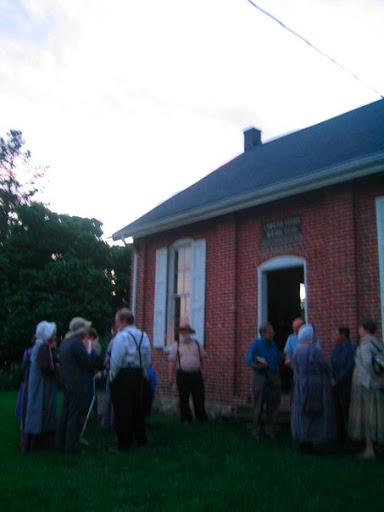
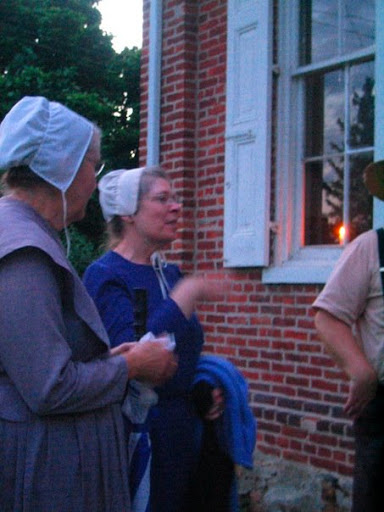
Visually, the group is striking. Every man in the room wore a long-sleeved white dress shirt buttoned all the way up, dark pants and black shoes; all had short hair and only one or two had facial hair. I was more distinctively plain in my broadfalls and suspenders but the effect of sixty-or-so men and young boys all dressed alike was visually stunning. Like a lot of plain peoples, the women were more obviously plain and all but one or two wore lightly-colored cape dresses and head coverings (I later learned that the exceptions were newcomers who weren’t yet members). Seated was segregated, women on the left, men on the right. Gender roles are very clear. There were kids – lots of kids – all around, and a big focus of the sermons was family living. One extended sermon focused on discerning between providing well for one’s family vs. greed and the balance between working hard for your family vs. giving up some things so you can spend time with them. Kids were present throughout the service and were relatively well behaved.
The church itself was called a meetinghouse and was plain – no crosses of course. People sat in pews and there was a raised area up front for ministers and elders. The building doubled as a schoolhouse during the week and its schoolrooms had a lot of Rod and Staff books, familiar from our own home schooling. A member described the school as one leg of the three-legged stool, along with church and family. If any one part of the equation was lacking in some way, the other two could help insure the child’s moral welfare. School was free for church members but was open on a tuition basis to non-Mennonites. These outsiders were required to make certain lifestyle choices that would insure the school stayed relatively pure; the most important requirement was that the family not have a television at home.
My regular readers will have one question on their mind right about now: did anyone invite us to lunch? Why yes they did! We didn’t even have to prompt it. We knew a couple there – M and J, who run a restaurant in the local farmer’s market, a favorite Saturday morning stop for us. They took us under their wing when they recognized us, sitting with us during worship and then showing us the school. J said that if we came back again we could come over for lunch. Then she backtracked and offered that we could come now, explaining that the church had had recent discussions over whether it was too pushy to ask first-time attenders to lunch or whether they should restrain themselves and invite them on the second visit. Wow, a church that thinks about this?!
So we followed them to their place for lunch. It was a wonderful opportunity to ask more questions and get to know one another. Meals are important. Julie and I had wondered why there were Mennonites in Vineland NJ of all places – and two Mennonite churches at that! Short story is that there had been a civilian public service facility in Vineland for conscientious objectors and Lancaster-area Mennonites decided that “the boys” stationed there needed the grounding of a local church community (apparently other C.O. camps were scenes of debauchery – Mennonite drag racing in Colorado Springs was cited). This became Norma Mennonite Church, which still exists and is another local church I’ve been meaning to visit for years (hi Mandy!). In the 1960s, there was a great round of liberalization among Mennonites, an unofficial abandonment of the distinctives codified in their books of disciplines. Many churches split and the Vineland Church was formed by those members of Norma who wanted to maintain the discipline.
This probably explains the strong focus on the rules of the discipline. For those wanting more of the histories, I commend Stephen Scott’s excellent “An Introduction to Old Order and Conservative Mennonite Groups” along with anything else Stephen Scott has written. The Vineland congregation is part of the Eastern Pennsylvania Mennonite Church conference, profiled on pages 173 – 176. A lot of the Mennonite issues and splits are echoed among Friends and we’d do well to understand these cousins of ours.
The result is a church that’s big on group practice: the dress, the lifestyle. M. told me that they don’t believe in theology but in Biblicism. He explained that they don’t think the Bible contains the word of God but instead that it is the Word of God and he paused to let the distinction sink in. The Bible is not to be interpreted but read and followed, with special attention given the gospels and the letters of Paul.
So no, I’m not going to go Conservative Mennonite on you all. I have a TV. My profession is web design (they’re not into the internet, natch). I’m married to a praciticing Catholic (I don’t know how they would bend on that) and at this point my brain is wired in a curious, outward way that wouldn’t fit into the normative structures of a group like this. Doctrinally-speaking, I’m a Friend in that I think the Word of God is the Inward Christ’s direct spirit and that the Bible needs to be read in that Light. There’s a lot of people who wouldn’t fit for various reasons, people who I would want in my church (they maintain a hard line against remarriage after divorce and I didn’t even ask about gay issues). But I have to admit that the process and structure puts together a really great community of people. They’re hard-working, kind, charitable and not nearly as judgmental as you might imagine – in practice, less judgmental than a lot of progressive religious people I know. Non-resistance is one of the pillars of their practice and they were genuinely interested in Julie’s Catholic church and my experiences among Friends and we talked a fair bit about Islam.
Normally I’d give a big thanks to the church and M & J here, except I know they won’t read this. I am grateful to their kindness in sharing their church, beliefs and family meal with us.