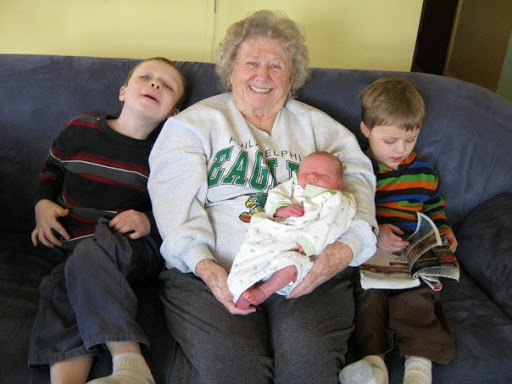
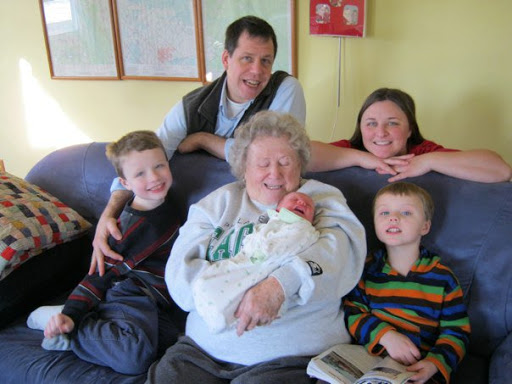
In album Julie’s family visits Baby Gregory (2011) (8 photos)




Google+: View post on Google+
 A bit of a milestone – I finished the One Year Bible reading plan last night! I managed to stretch it out to 27 months but that’s alright. I started in January 2009 and initially kept the daily readings going till May of that year, when I feel hopelessly behind. I kept a mental note of the date and in May 2010 I started where I had left off. I kept reading regularly until the last week in December, when I was understandably distracted by the birth of our third son Gregory on 12/28. Knowing I wanted to keep the cycle going, I skipped that week and started again on January 1, 2011. It was only last night that I went back and finished up that last week – featuring Malachi and Revelations (which has the Lamb’s War metaphor so important to early Friends).
Thanks go to Gregg Kosela and AJ Schwanz for letting me know such a thing as one year Bible reading plans existed. I had never been able to stick to a regular Bible-reading regimen before. The grandmother who frequently declared me a Bible illiterate would be so proud! (Actually not, she’d find something else to critique, but her hangups around family and “Christian” living are a much longer blog post!).
It’s been great having a regular spiritual practice. I’m glad I can find my way around the Bible now and my understanding of Friends has deepened. The early Quaker writings are steeped in Biblical allusions and we miss a lot when we miss those references.
Michael Oliveras is a long-time union carpenter making the entrepreneurial jump and starting his own business: Mike’s Precision Carpentry, serving the New Jersey, Pennsylvania and Delaware from his shop in Hammonton, NJ. He came to me looking for a webpage to advertise his new enterprise.
It’s a simple design, a typical small-business site of half-a-dozen pages. The color scheme matches his business cards for a bit of branding. Oliveras faced a problem typical for new businesses: a lack of good photos. The work he’s done for many years is not technically his own (per the employment contracts) so for now the pictures are a mix of the few jobs he has done on his own and a few stock images. I’m sure he’ll have a well-rounded portfolio before long and we’ll be able to fill out the site with his own work. In the meantimes, he added a couple of great pictures of him and his family on the “About Us” page to give it that personal touch.
See it live: www.mikesprecisioncarpentry.com
It’s up on the sidebar and featured on QuakerQuaker, but I want to give an added boost to my friend Kevin-Douglas’ post “Why I bother with religion.” I’ve written about the Emergent Church / Quaker experiment that Kevin-Douglass is helping to organize down in Baltimore. Check out their new’ish website, http://www.setonhillfriends.org/
Here’s a snippet of today’s post:
Organized religion is based in community. Being in a community challenges me. Simply hanging out with my friends and engaging my family isn’t enough. The risks of such an intentional community and the support available therein offer so much more than if I just do what comes easily or go along with what exists around me. I’m challenged in community. I’m held accountable. And while it could be said that I could get this out of a gay rights group, or being part of an ethical society, the truth is that in a religious community, we all seek to go much deeper than the psychological or emotional levels. We seek to understand that Mystery — God. We seek to understand that transformative and healing power that comes from that Mystery.
Kevin-Douglas originally posted it to Facebook earlier today and I asked if he would sign up to QuakerQuaker and post it there. There’s a lot of great stuff that goes up on Facebook and it’s a useful tool for keeping in touch with friends, but most posts are not visible beyond your own Facebook friends list (it depends on your privacy settings). If you post something really good about Friends or belief on Facebook, seriously consider whether you might repost it somewhere more public. If you don’t have a blog handy, you can do what KD did and post it on QuakerQuaker, where every registered user has blogging capabilities (it creates a bit of a metaphysical connundrum for the QuakerQuaker editors, as it means we’ll be linking QQ posts to the QQ site, but that’s fine).
I’ve been much afflicted on the subject of plain dress for the last several months, thanks to Thomas Clarkson. Clarkson, a British Abolitionist and close, even fond, observer of Friends, wrote a three-volume disquisition on Quaker testimonies, culture, and behavior (in 1811, if my memory serves me). There’s a lot in Clarkson to think about, but his section on Quaker garb was particularly interesting to me. Not because I intend to take up a green apron any time soon (did you know that was a badge of Quaker womanhood for nearly two centuries?), but because he provides what a present-day anthropologist would describe as a functionalist analysis of the meaning of plain dress: it served as a badge of membership, keeping its wearers peculiar and in visible communion with one another, while communicating a core value of the tradition.
When I was a kid, I yearned for plain dress like the kids in Obadiah’s family wore. I loved the idea of a Quaker uniform and couldn’t imagine why we didn’t still have one. Whenever I asked my mom about it, she would patiently explain that an outward conformity in plain dress called attention to itself as much as any worldly outfit did, and that Quakers should dress as plainly as was suitable and possible to their work in the world. It made sense, but I was still sorry.
And now, at nearly 40, after 35 years of balancing my convictions and my world, I’m still hankering after a truly distinctive and Quakerly plainness. What isn’t any clearer to me is what that might look like now.
After all, what are the options? According to my partner, the distinctive elements of contemporary Quaker garb are high-water pants for Friends over 40 and grimy hands and feet for Friends under 40. This obviously jaundiced view aside, there doesn’t seem to be much to distinguish Friends from, say, Methodists, Unitarians, or members of the local food co-op. A little denim, a little khaki, some suede sport mocs, some sandals and funky socks, batik and chunky jewelry. It’s not obviously worldly, but it’s not set apart, either. There is no testimony in our current dress.
On the other hand, anything too visibly a costume obviously isn’t right; I can’t appropriate the Mennonite dress-and-prayer-cap, for example. And my heart rises up against the whole range of “modest” clothing presently available – floral prairie dresses and pinafores, sailor dresses, denim jumpers, and head coverings – all with nursing apertures and maternity inserts, and marketed by companies with terrifying names like “Daddy’s Little Princess,” “King’s Daughters,” and “Lilies of the Field.” No Prairie Madonna drag for me. No messy, time-consuming, attention-requiring long hair; no endless supply of tights and nylons and slips; no cold legs in the winter snow and ice. No squeezing myself into a gender ideology which was foreign to Friends from the very beginning.
It seems to me that contemporary plain dress ought to be distinctive without being theatrical; it should be practical and self-effacing. It should be produced under non-exploitive conditions. It should be the same every day, without variation introduced for the sake of variation, and suitable for every occasion It should be tidy and well-kept – Quakers were once known for the scrupulous neatness of their attire and their homes. And it should communicate clearly that we are called and set apart.
But what garments they might be that would accomplish that, I cannot say. I’m stymied. Friends, share your light.
*Note from Martin Kelley:* I’m starting to collect stories from other Friends and fellow-religious on issues like plain dress, the testimonies and faith renewal. This is part of that project.