Thoughts on the surprise Truitt family visit yesterday, because I know Quakers can be really really bad at this… Make sure you have a website that lists a phone number that rings through to a real person in real time. One that also lists an email that will be promptly read and answered. This event came together pretty fast. From the first phone call from township official Stacy Webb late Tuesday afternoon to my unlocking the meetinghouse doors was about 24 hours.
I was on a video call when Stacy’s first call came in so I had to let it go to voicemail. So also have voicemail set up. After my previous call ended I was able to reply to Stacy’s email and then followup with a quick call to confirm details. This was one less detail she had to worry about in an event with lots of moving parts. (In addition to a half dozen Truitt family members we had the mayor, deputy mayor, township manager, a police liaison, and a communications staffer with a camera. That’s a lot of people to coordinate.) In a lull in the event, Stacy told me it was great that she find and reach someone at Cropwell Meeting so easily.
I know communication can be hard but we need to be accessible. I’ve been ghosted SO MANY TIMES when trying to call or email Quaker meetings. And it’s not just the small ones that don’t get back to me. Sometimes meetings with paid office staff also don’t return messages. Cropwell uses a Google Voice number to forward phone calls to my personal cell and emails also automatically forward to me. It’s not overwhelming, not in the least — I let things forward to voicemail when I need to and I have ringers turned off at night. But because Cropwell set this up even before I became involved, I’ve been able to respond to inquiries quickly, once even as I was driving to meeting on Sunday morning (don’t worry, I pulled over). People already think we’re extinct. Don’t give them more reasons to think that’s true.
I love it when cultural essayists rediscover a core Quaker observation about plainness and human nature and give it a new name. Remember a few that’s ago when “normcore” became a thing?
First off, I’m not sure I really buy it from a cultural tech perspective. The original Facebook ideal of wide social graphs and public accounts feels like a dinosaur. I picked up this article from Jason Kottke, who notes that “blogs have global context.” Twenty years ago, yes, many of us were living very public online lives — or at least made an image of ourselves that was very accessible on blogs and in networks like the OG image-sharing network Flickr, which defaulted to public access.
I don’t think that’s the case anymore. Gen Z is mostly absent from public spaces like Facebook and usually keeps pretty locked-down accounts. The app that has come to define the 2020s is TikTok (and its clones), which is a highly performative space where most of us consume, not create. I had a great after-meeting talk with two younger Quakers this weekend about outreach. Most of their discussions happen on various Discords, networks so private you generally can’t even find out about particular “server” except through word of mouth. When I asked them how interested seekers were supposed to find local Friends if everything was locked down on private networks, one of them suggested there should be an email list. I’m glad I wasn’t drinking any coffee at that moment because I would have had a real-life spit take. My first Quaker organizing thirty years ago was putting together an email contact list first for YAFs in my area and then worldwide because I didn’t see anyone else doing it. Back then local YAF networks were invisible to outsiders because the web as we know it barely existed. One could argue that GenZ has reinvented the privacy but also invisibility of the 1990s.
But granting the “uni-context” conceit for argument, this is a big post of Quaker plainness. Yes there were mostly unwritten rules but if you open up an old copy of one of the *Books of Discipline* and turn to the plainness section, you’ll find that it focuses on intention. My favorite query asks if you dress in a way “calculated to please a vain and wanton mind.”
It is the Quaker concept of *intregrity* at play. Going back to root meanings, something that is integral cannot be broken into pieces without losing its identity. We should act and present ourselves in the same way in all context. Who we are should be who we are, whether at work, play, church, etc. Similarly our *yeas* should be *yeas* and our *nays* *nays* in all context so that we don’t need a special incantation of swearing to tell the absolute truth.
Of course our lives are complex. I’m a runner and I put on running gear when I go out, especially in the August heat. But I’m not doing that for a calculated reason but a practical one. And I often have a pre-run running shirt on when I log into a work Zoom call.
Anyway it’s sort of sad that so many Friends have consigned old Quaker practices to the dust heap. The ethics, if not the details, might be something philosophers are seeking today.
If you ask about Quaker beliefs these days, one of the common answers you’ll get is SPICE, a handy acronym that holds together a hodgepodge of values, namely: simplicity, peace, integrity, community and equality (and later sustainability to become SPICES). One Quaker school definitively puts it, “Quakers agree to a core set of values, known as testimonies.” I’ve not found SPICES listed before 2000 and even many of the individual components are absent from older books of Faith and Practice.
The question of where this ubiquitous acronym came from, and when, regularly comes up in Quaker discourse (mostly recently on Reddit here). I sometimes answer with the bits I’ve dug up but rather than reinventing the wheel each time, I thought I’d write it all down. I invite people to add what they know in comments and I’ll edit this.
1940s
Howard Brinton was the inventor of our modern idea of a “testimony” in the 1940s, and his original list was community, harmony, equality, and simplicity. He was the Philadelphia-area born Friend who helped organize unprogrammed Friends on the U.S. West Coast in the early part of the twentieth century. Brinton had a knack for simple explanations that expressed the emerging consensus of a new generation of Friends who were healing from the nineteenth-century schisms. Finding new ways of talking about our commonalities was a central part of the work of reconciliation. From his tour de force 1952 masterpiece, Friends for 300 Years:
The meaning of the group in Quaker practice can be suggested by a diagram. Light from God streams down into the waiting group. This Light, if the way is open for it, produces three results: unity, knowledge, and power. As a result we have the kind of behavior which exists as an ideal in a meeting for worship and a meeting for business. Because of the characteristics of the Light of Christ, the resulting behavior can be described in a general way by the four words Community, Harmony, Equality, and Simplicity.…
He included a chart, which honestly doesn’t help much with my understanding of the metaphysics of it all.
1975
Reader Tomas Mario Kalmar sent me a paper called Learning Community prepared by the Education Commission of Australian Yearly Meeting that lists six “characteristics that distinguished Quaker education”: a religiously guarded education, community, non-violence, equality, simplicity, and an experiential curriculum. The list is largely based on Howard Brinton’s work but I include it here because it shows how Friends were remixing and repurposing his list. Learning Community actually looks pretty good and fairly timeless and Tomas gave me permission to repost the PDF here.
1980 – 90s
In a Reddit thread a few years ago, macoafi wrote: “My in-laws were children in first day school in the 1980s and 1990s, and they learned 4 testimonies, no acronym. (Peace, truth, simplicity, equality).” At some point Brinton’s harmony started being called peace so this is mostly his list except for truth being swapped for community.
1981
Commenter Sharon writes:
I first heard SPICE at the 1981 FGC gathering in Berea KY! At the time it didn’t sit well with me as I found it too glib. I was still working out what God wanted my life to testify too.
This would put it nearly two decades before from any documented instance I’ve seen. It is also well before any instance I’ve seen that included an I for integrity. I admit I’ll remain skeptical until I see further evidence, though it is possible that someone remembered it from the Berea gathering and started reusing it in the last 1990s.1
1990
Wilmer Cooper was an Ohio Wilburite Friend who went on to become first dean of Earlham School of Religion upon its founding in 1960. Thirty years later he published A Living Faith, which was built on an ESR course called Basic Quaker Beliefs. In the preface he writes: “It is my hope that this work will help Friends gain a fuller understanding of their Quaker heritage and theological roots, while providing for non-Quakers a comprehensive answer to the questions: ‘Who are the Quakers?’ and “What is Quakerism?’ ” In its final chapter Cooper has two lists, which each have four testimonies. His religious testimonies are:
belief that we can have direct and immediate access to the living God;
we can no only know the will of God but can, by God’s grace, be enabled to do the will of God.
the Quaker experience of of community as expressed in the “gathered meeting.”
the sacramental view of life.
His social testimonies are:
Peace Testimony
simplicity
equality
integrity
He expands to give a paragraph to each of his eight testimonies but obviously the second list is much pithier.2. He does say that this isn’t a canonical list, that different Friends will have different lists, and concludes the section on testimonies by, well, testifying: “Friends believe deeply that if they submit themselves to God and live by the Light of Christ they will be enabled to live by the truth of the Gospel.” It’s worth noting that the later SPICE/S formulation didn’t include any of the religious ones (you could perhaps try to claim community dervices from his religious testimonies list but I don’t generally hear the SPICES C described in the kind of spiritual language Cooper used).
The next year Cooper wrote a Pendle Hill pamphlet that focused on integrity. As far as I’ve seen Cooper is the first to include an I for integrity, setting the stage for our familiar acronym.
Mid-1990s
My wife Julie insists that she remembers talk of SPICE/S back when she was in high school starting to get involved with Friends (circa 1994). She didn’t attend a Quaker school so this would have been in Philadelphia Yearly Meeting circles, probably specifically South Jersey.
Late 1990s
In a comment to this very post, Pendle Hill editor Janaki Spickard Keeler says that when she was working a 2023 pamphlet with Paul Buckley, they tracked SPICE/S to a Friends Council for Education listserv for educators (perhaps E‑Quakes, which was started in 1996 according to a FCE history). Janaki writes: “No one came forward as being the first to come up with the idea, but they shared it along themselves and it spread. They estimate this happened around 1998.” The pamphlet quotes Tom Hoopes, who started as director of education for Philadelphia Yearly Meeting in 1998: “I encountered it in use by one of the monthly meetings of Philadelphia Yearly Meeting, and I thought to myself, ‘what a great mnemonic device for helping people to remember what we Quakers claim to prioritize, and to try to practice!’” Tom told Janaki and Paul that he didn’t remember the identity of the Friends meeting.
1999
The Summer 1999 edition of Salem Quarter (N.J.) News reports that Woodstown Meeting created a SPICE rap in for a First-day School program which also included songs from Spice Girls. Yes it’s as unique as it sounds:
What’s the word? SPICE!!!! What’s the word? SPICE IS THE WAY TO GO!!!! Simplicity is simple, and you know it’s right. Squanderin’ money gets ya into a fight. Peace, it rules, and you know that it’s true. It’s the thing I need to get along with you. Don’t yell and sing those fightin’ songs, when you can help others and right their wrongs. Integrity is always bein’ true to your word. It’s the most honest testimony I’ve ever heard. Livin’ and a‑sharin’ all together’s really fun. Community is helpin’, workin’, playin’ all in one. Equality means everyone is equal, and that’s cool. Respecting other is what’s right and is the golden rule!!
Note that the article gives a clue on source: “After reading a short article in Philadelphia Yearly Meeting News with the acronym SPICE highlighting the testimonies… [we] were inspired to incorporate this into our First Day School Program at Woodstown MM.” The oldest copy of PYM News available via Archive.org is tantalizingly close — Nov/December 1999. That seems to be when PYM started posting its newsletter.3
I myself first complained about SPICE in 2004 (note it hadn’t gotten a second S yet). I complained that this kind of list of secular testimonies were too restrictive. I really was a Quaker Ranter back then; also I was really kind of hard on Brinton, who I appreciate more now.
2006
I like to search the Friends Journal archives to see when new terms show up. New terms are often bandied about by particular Friends or within sub-groups, where they might circulate for a few years without getting into wider usage. As far as I’ve been able to determine, the first reference to SPICES in Friends Journal is a 2006 article by Harriett Heath titled “The Quaker Parenting Project: A Report.” She’s lays it out as an attempt to teach Quaker children without resorting to dogma:
There are several different lists of testimonies. We started with one commonly referred to by the acronym SPICES: Simplicity, Peace, Integrity, Community, Equality, and Stewardship — but we found that there were other issues not addressed by this list. Service is an integral part of Quakerism in our efforts to live our faith; should it be a testimony? Education has been historically an integral part of Quakersim; should it, too, be included? Where does worship — time set apart — fit in?
Her project eventually picked a different list because they didn’t want to be bound by the dictates of fitting into an acronym. They included conflict and growth and service (which sometimes is listed as the final S).
2007/2008 videos
In 2007, British Friends could produce a video called “The Quaker Testimonies” that didn’t mention SPICE/S and ranged over other non-acronymed testimonies such as one for respect and another against oath-taking. If you listen carefully, I think at least one of the speakers must have heard of SPICE because he seemed to be organizing thoughts around it.
Brinton scholar Anthony Manousos did a deep dive on SPICES. Although Anthony claims Briton invented SPICES per se, I think he just invented the idea of testimonies and the initial list that included three of them (four if you count the harmony/peace change).
2011
Less than two years after Heath’s article, Mark Dansereau and Kim Tsocanos, the co-heads of Connecticut Friends School in Wilton, Conn., published an annotated list of SPICES in Friends Journal, explaining that their school was built on these “Six Quaker Values” (yes, italicized and capitalized) and that they applied and wove them into each activity in their curricula. This might be one of the oldest fully-intact listings still easily available on the web. This has become one of the most visited pages on Friends Journal website.
Paul Buckley gave a talk in 2012 that highlighted the role of Wilmer Cooper, an Ohio Friend perhaps most well remembered for founding Earlham School of Religion in 1960. In 2023, Paul Buckley wrote a pamphlet from Pendle Hill, Quaker Testimony: What We Witness to the World, edited by Janaki Spickard Keeler, during which they determined the late 1990s date.
2013
Someone around 2006 I was standing in a meal line at a Quaker event with California Friend Eric Moon and we started to talk about testimonies. It was the start of a great conversation, cut short by some interruption or another before we even hit the dessert station. When I started as FriendsJournal editor I asked him to write something. 2013’s Categorically Not the Testimonies was the result. We also talked in an early Quaker Author Podcast.
So where did the SPICES formulation come from? It ultimately derived from Brinton’s list, with harmony morphing to peace and WIl Cooper’s integrity adding an I. Given its pedagogical nature, it was probably coined by educators. It’s a good teaching tool, easy to remember and something you can easily weave into a multi-week class.
Since there’s nothing particularly religious about the SPICE/S list, it can work in an essentially secular environment that might be allergic to religious-sounding Quaker theology. This would include Friends schools appealing to a non-Quaker audience or a Liberal Friends Meeting that wants something non-controversial to teach the kids. I never hear anyone talk about it being derived from “characteristics of the Light of Christ,” as Brinton did when he introduced it.
In the last few years it’s become pretty ubiquitous on TikTok and other short-form video (Discovering Quakers, _gloyoyo_, itsmekatevee).4 If you have five minutes to tell a general audience about Quakers, bite-sized descriptions are important. Also: some of these content creators are probably younger than the term itself. Also: I’ve finally grown into the Old Man Yelling at the Clouds meme. SPICES is here to stay.
Is SPICES all that terrible? No, not really. It can be handy. But it is pretty annoying that we’ve confused a list of generic values for belief. And it’s super annoying that even that list of values is hemmed in by the requirement that every component fit into a silly acronym.5
What’s funny about the mystery of this is that there’s a very good chance that the person who first listed out SPICE is still around. There’s a box in someone’s garage packed with late-1990s newsletters, one of which lists it out for the first time in print. Anyone with any information can comment below or email me at martink@martinkelley.com.
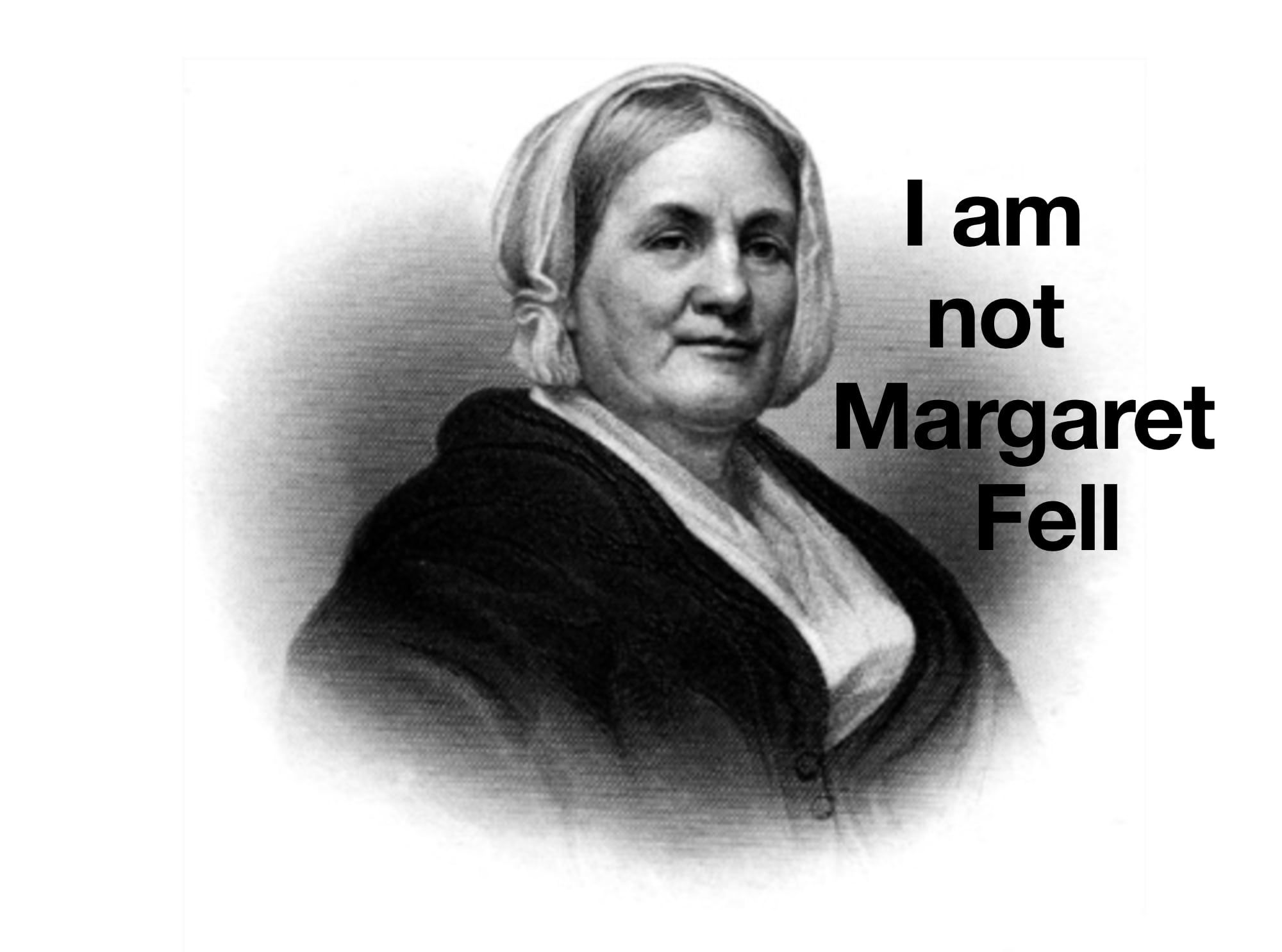
In the past couple of of months I’ve noticed various Friends using this image of Margaret Fox as a stand-in for Margaret Fell, the so-called “mother” of Quakerism who later married George Fox. Unfortunately it’s a few centuries late. This picture is Margaret Fox of Hydesville, N.Y. It’s from an 1885 book called The Missing Link in Modern Spiritualism, in which she and her family describe their haunted house. Their three daughters, Margaretta, Kate, and Leah, became known as the Fox Sisters, and became the most famous trio in nineteenth-century Spiritualism. In later years Margaretta admitted the hauntings were hoaxes, alas.
There is a Quaker connection, as the sisters helped convince leading radical Hicksites Amy and Isaac Post to adopt Spiritualism and start communing with the dead. Issac later wrote “spirit writings” under the bylines of people like George Fox and Benjamin Franklin.6 It would be super easy to make fun of the Posts but they also opened their home as an Underground Railroad stop and were personal friends of William Lloyd Garrison, Susan B. Anthony, Sojourner Truth, and Frederick Douglass (who they helped escape to Canada after he was implicated in the John Brown raid at Harper’s Ferry). They were leading figures in what became known as the Progressive Friends movement, whose energy is still palpable in Liberal Quaker circles.
The internet being what it is, there are plenty of websites that have taken this out of context and presented it as Margaret Fell Fox. Unfortunately there are no contemporary images of Margaret Fell. The best we have is a twentieth-century representation of her by Robert Spence, who over thirty years made a number of charming line drawings of the life of George Fox (Friends Journal used one for an illustration in a recent article).
I am writing this post simply to show up in future search results. If I can prevent one person from mistakenly using this image as an illustration or basis for a piece of art then it will have been worth it.
Also, FYI, this is what portraits looked like in Margaret Fell’s time:
Last week my son Gregory’s scout troop headed to southern Pennsylvania to start a 50-mile backpacking trip south, to cover all of Maryland’s portion of the Appalachian Trail and end up in Harper’s Ferry, West Virginia. I was asked to drive them, and as it seemed a little too far to commute back to South Jersey I spent four days by myself down there and had a great time. I thought I’d share various thoughts:
Hostels are great. I haven’t stayed in a hostel in forever but at $35/night, the price was right. I’m so glad I did. Every night was a new cast of people to get to meet, quirky and fun and delightfully weird. This was the weekend of the Flip-Flop Kickoff festival put on by the Appalachian Trail Conservancy. As I understand it, the “flip flop” is an alternate way of doing a through-hike on the Appalachian Trail (“the AT”). Instead of starting in Georgia and heading north along with hundreds of others, you start in Harper’s Ferry (the honorary halfway point) and go south, then find a ride back to Harper’s Ferry and go north. The festival brought a lot of hikers to Cross Trails hostel, where I stayed, and I even participated in a few events; I felt myself an honorary AT hiker!
I loved the ambiance and the characters at Cross Trails Hostel. The staff were great.
I love my bike. I put my bike rack on my old econobox car and used it every day to commute the five miles or so from the hostel to Harper’s Ferry. The C&O Canal Towpath is a mostly flat, beautiful trail that winds 180 miles alongside the Potomac River. One day I continued north from Harper’s Ferry and rode it to Shepardstown: a beautiful ride apart from the calf-breaking bluffs on either side of the trip.7 Also a lot of outdoor fun is whitewater rafting. There’s three companies in the area offering it and I had a good time with Harper’s Ferry Adventure Center.
The C&O Canal Towpath trail is wonderful.
Don’t forget the non-vegan restaurants. I was excited by a vegan option in Harper’s Ferry but my favorite meal by far was at a regular cafe in Shepherdstown. I had an amazing homemade black bean veggie burger, a sesame noodles appetizer, decent fries, and a tall cold glass of hard apple cider. Five stars to the Blue Moon Cafe. Extra bonus: there’s an actual creek flowing through the back patio.
Five stars to Shepherdstown’s Blue Moon Cafe.
There is so much history atop itself in Harper’s Ferry. It’s a tiny town and yet every time you turn around there’s something monumental going on. John’s Brown raid is perhaps the most famous but it was also the site of multiple Civil War engagements, a provisioning stop for Meriwether Lewis, and a place where Thomas Jefferson waxed poetic.
The Oddfellows Hall. One of their members was taken hostage by John Brown. As if that’s not enough history, famed Civil War photographer Matthew Brady set up his camera here and took lots of pictures of soldiers from this vantage point.
Don’t defend Harper’s Ferry. There’s much one could say about John Brown’s motivations, tactics, etc., but really dude, how dumb do you have to be to try to force-start the Civil War there of all places? As soon as word got out about what was happening, militias from three states and federal troops poured in from the hills on all sides of the town and trapped him. It was over almost as soon as it began. The Civil War engagements were like that too. It’s a fishbowl with mountain ridges on all sides: you just set up your munitions on Maryland or Loudoun Heights and lob cannon balls down on the town until you get a surrender. A quote attributed to a Union lieutenant in an exhibit really summed it up for me: “Gen. Jackson and Gen. Hill told me personally, they had rather take it [Harper’s Ferry] forty times than to undertake to defend it once.”
These are the little hills behind Harper’s Ferry. On either side are much taller ones.
Visiting new meetings is great. On Sunday morning I had church time so I motored south to visit Goose Creek Meeting in Lincoln, Virginia. 8 It’s an old meeting, steeped in its own history. It’s aways fun to see a new meeting. They have honest-to-God pews with hymnal racks along the back, each carefully stocked with a Bible, an FGC hymnal, and Baltimore’s Faith and Practice. They have a loud clock, which I’ve always heard was a Hicksite marker and indeed I later learned the Hicksites held the meetinghouse in the nineteenth century schisms.9 There were only two messages and one was a fake Gandhi quote (you all will be happy that I didn’t fact-check it in real time and just let the sentiment behind it stand for itself). It seemed like a really grounded meeting. I was impressed that people got there early and sat quietly preparing for worship. Everyone was very friendly for the few minutes of coffee hour I could squeeze out before heading back north to pick up scouts.
Nice light in the main room before worship. Note the hymnal racks on the back of benches and also the prominent clock.
Really glad to see UK’s “The Friend” redesigning their website. It’s now mobile friendly and also allows visitors to read up to three free articles. I like sharing occasional articles from there so I’m excited that readers will be able to easily see them — and consider subscribing.
So yeah, THAT Lin-Manuel Miranda. I’m going to have Moana songs in my head all day now. See the line where the sky meets THE sea? It calls ME, And no one KNOOOOOWWS, how far it GOOOEEES. (okay, it sounds better when my 8yo daughter sings along in the car).
Nicole Cliffe is a former atheist turned Christian (but AFAIK, not Quaker (yet)) who told her conversion story in Christianity Today a few years ago. One of her claims to fame is co-founding The Toast, which stop publishing in 2016 but still has someone paying for the web server.
And in case Lin-Manuel swings by, he should know that history geek Quaker hip hop is a thing.
This year’s election feel different than previous years. People are ready to do something besides just voting. Many are running for office in record numbers, for example: Scientists and Women.Another population that is running in, perhaps, record numbers in 2018: Quakers!
He’s added a lot of interesting contextual links to articles about the new types of candidates we’re seeing in the 2018 election.

 www.derekthompson.org