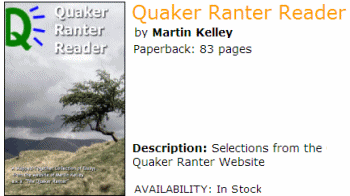
A recent email correspondence confirmed that all of our wonderful websites aren’t always reaching the people who should be hearing this message. Self publishing a book is almost as easy as starting a blog so why not put together a booklet of a website’s essays? You can order the first edition of the “Quaker Ranter Reader”:http://www.cafepress.com/Quakerranter.18423631 for $12.00 through Cafepress (a few dollars of each sale comes back to me to support the website). The Reader is also available from “Quakerbooks of FGC”:http://www.Quakerbooks.org/get/11 – 99-01749 – 3.
Quaker Ranter
A Weekly Newsletter and Blog from Martin Kelley
Tag Archives ⇒ Quaker
Quaker Dharma: Let the Light Shine
February 2, 2005
Over a new-to-me blog called The Quaker Dharma there’s a post calling for us to The Let Our Light Shine Brightly. He makes some very good points like “It’s worth explaining what Quakerism is” and “true outreach is an act of spiritual hospitality.” He also tells a few stories. Here’s one about passionate younger religious he’s known:
I came to Quakerism from Buddhist study. I also worked for an international Buddhist organization for two years. These are experiences for which I am deeply grateful. Teachings for which I am deeply grateful. I saw twenty something year olds who took Buddhist ordination vows and shaved their heads. This was deeply moving and was a joy to share their sense of union at having committed to a path. These kids were flying to India to take teachings. The commitment level was unbelievable. Some of them went on month long silent retreats. Quakerism, especially now, in these times could speak to many. Unfortunately we hide it and thousands and thousands of people in their twenties and thirties go without a spiritual home.
FGC Gathering Workshop
January 29, 2005
This fall Zachary Moon and I put together a workshop proposal for the 2005 Gathering, which has been approved: “Strangers to the Covenant” is the title and here’s the short description:
This is for young Friends who want to break into the power of Quakerism: it’s the stuff you didn’t get in First Day School. We’ll connect with historical Quakers whose powerful ministry came in their teens and twenties and we’ll look at how Friends wove God, covenants and gospel order together to build a movement that rocked the world. We’ll mine Quaker history to reclaim the power of our tradition, to explore the living power of the testimonies and our witness in the world.
This was very much an “as way opens” process. At the 2004 Gathering I felt sad that there weren’t more workshops that I’d like to attend. And obviously I have a long-standing concern to support younger Friends. But I wasn’t sure if I had the skills to handle this. One piece of discernment was leading the Quakerism 101 class at Medford Meeting: I knew I would have most of the sessions under my belt by the time the workshop submission deadline came around and I hoped I’d have a feel whether I actually like leading workshops!
The Medford experience was surprisingly good, even on weeks where I could have been better prepared. I learned a lot and gained confidence in “teaching” Quakerism to Medford’s class of very weighty, experienced Friends.
Still, the Gathering workshop submission deadline was looming and I had no specific topic in mind. Julie, my wife, was getting a little suspicious whether the workshop would happen or not. I knew that the most important thing was attracting the right mix of eager, curious participants and that for me the topic was almost secondary. Still: a focus and topic is important, yes.
The week before the deadline, I attended the FGC Central Committee meeting in New Windsor, Maryland, as a staffperson. In a lunchtime discussion I learned that my friend Zachary Moon was also considering leading his first workshop. As soon as we sat down and started talking it seemed like the obvious thing to do. The discernment to co-lead this took two a half seconds or so, but of course this quick process was built on the thought, prayer and discernment both of us had already been giving the matter. I’ve found that when I’ve laid the groundwork for a decision, things can often move suprisingly quickly.
The workshop has developed differently than I suspected. The most signicant piece is its age limitation: it’s for high school and adult young Friends only, meaning it’s participation is limited to 15 to 35 years olds. I’ve always been a little worried about constructing youth ghettos but I think it will work in this case. I apologize in advance to those Quaker Ranter readers who might like to take it but can’t because of age (I’m too old myself, after all!). There will be many other chances to spend time at Gathering and Zachary and I are only a part of a shift that’s been happening at the FGC Gathering over the last few years.
Kwakersaur: Jesus vs Christ vs Discernment
January 26, 2005
“Interesting short post”:http://kwakersaur.blogspot.com/2005/01/jesus-language.html from Kwakersaur about the different ways Friends have related to God circa 1660, 1950 and today. A snippet
bq. [The first generation of Friends’] language lacked the me-an-Jesus kind of spirituality that marks the 1955 minutes and characterizes a lot of Christian spirituality of today. For early Quakers — and I suspect early Christians — it was not so much Jesus as a friendly affable fellow who loved us in a warm and comfy positive-strokes-I’m-OK-You’re-OK kinda way.
Selling Quakerism to The Kids
November 23, 2004
A few weeks ago I got a bulk email from a prominent sixty-something Friend, who wrote that a programmed New Age practice popular in our branch of Quakerism over the last few years has been a “crucial spiritual experience for a great many of the best of our young adult Friends to whom [Liberal Friends] must look for its future” and that they represented the “rising generation of dedicated young adult Friends.” Really? I thought I’d share a sampling of emails and posts I’ve gotten over just the last couple of days.
Johan Maurer: More about boldness
November 12, 2004
Johan has a great post about “Quaker evangelizing in Russia”:http://maurers.home.mindspring.com/2004/11/more-about-boldness.htm that really applies to Quakers reaching out anywhere. My favorite paragraph:
bq. I personally have a hard time with hobbyist Quakerism, especially when defined in terms of ultrafinicky prescriptions of how “we” do things, “our” special procedures and folkways, or anything else that detracts from Jesus being in the center of our community life. How can we present something so stilted and crabby and culturally specific as an answer to spiritual bondage? It is just another form of bondage!
Nonprofit Website Design and Measurement
October 30, 2004
A 2004 Denominational Website Report
When I wrote this in the Fall of 2004, I was working as the webmaster for Friends General Conference, the US/Canadian denominational body for the liberal branch of unprogrammed Quakers. As webmaster, I felt that one of my most important responsibilities was to understand how religious seekers use the internet and how our nonprofit organization could benefit from understanding these patterns.
My 2004 report on the three FGC websites touched on a lot of these issues. I offer it here because I hope it can give other nonprofit and denominational websites some ideas about how to measure their site’s use. Too often we put up websites without any follow-up analysis of their use. You just can’t make an effective website like this and if your work is ministry you don’t want its reach constrained by minor navigational design issues. Please feel free to use the comment page to start a discussion on any of these issues.
State of the Websites
Report for FGC Central Committee, October 2004
By Martin Kelley, webmaster
It’s important to start off with a little editorial about why we need reports like this. We put up a website and we know people use it. Why bother spending time collecting data?
The internet is simultaneously vague and precise. We can say definitively that the FGC website received 114,097 “unique visitors” in the past fiscal year. But how many people does that represent? Is that a high number or low number? How did these users react when they came to the site. Did they think to themselves “whoops, not what I want” and leave, or did they go “wow, what’s this FGC?, hey this is great.” LESSON: We need data to know if the site is being used well.
Everyone who reads this report is by definition an insider. None of us are able to step into the shoes of an unknowledgeable seeker. In my study of usage patterns, I have found that the differences in website use between Quaker insiders and seekers is so great that they might as well be looking at different websites, if not different media altogether (see How Insiders and Seekers Use the Quaker Net.
Because of this gap we cannot design the site based on whims or personal preferences. It is incredibly difficult to imagine how newcomers might navigate the site. We can only consider the design of the site after we’ve examined in usage, both in detail (actual users moving through the site) and in aggregate (pages and links visited over periods of time). See also: How to measure the peace movement. LESSON: We can only effectively design the site if we incorporate sophisticated and detailed data about how the site is being used.
Part 2, Googlization
By far the most significant change in our websites over the past year has been the “googlization” of Quakerbooks and Quakerfinder, both of which now have over four times the visitors they were getting last year.
The Google Problem: Both Quakerbooks and Quakerfinder have had great content from their start. The former lists the entire inventory of FGC’s bookstore, along with book descriptions and reader commentary. The latter has our list of meetings – addresses, worship times, and contact information. But on both sites the bulk of the content was locked up in databases. Before users could benefit from the sites, they had to find them. This limited much of the use to people who already know about FGC and our resources. Because internet search engines can’t search website databases (a problem known as the hidden or deep web), they could index only a limited number of pages on these sites and they made referrals on only the most generic search phrases (e.g., “quaker bookstore” “quaker meeting directory”).
We made various changes to both sites (technical details below) that have made them searchable by Google and the other search engines, which now return our sites for very specific search queries, e.g., “Quakers in conflict Ingle” and “Quakers Poughkeepsie”.
A Wider, More Inclusive Audience: What’s great is that this has given us not just a bigger audience, but our target audience. Most of these visitors don’t know enough about how Friends are organized to even know where to look for information. With Quakerfinder and Quakerbooks, we’re now be visible on their terms.
We’re giving them the basic information they’re seeking and we’re doing it when they are actively seeking it. This last point is important. I spend a lot of time watching how people use websites. If you email someone out of the blue with a link to a website, they might follow it but only half-heartedly. They might be doing five other things at the same time and they rarely stay to full use the website’s resources. When someone comes to a site via a search engine they’re much more likely to look around: this is the visit that they are initiating because they have something specific they’re trying to find.
Having a “googlified” Quakerfinder means we’re actually reaching people who are ready to try out a Quaker meeting and we’re giving them that most basic information that’s often hard to find. With a searchable Quakerbooks we’re selling books to people who might not even have thought about Quakers as a possible spiritual path. I suspect that both sites are doing more outreach about Quakerism than any of us expect.
Update, 11/29/04: I recently met someone who came to Friends after reading the Quaker entry in Wikipedia. He had gone through the list of religious denominations in the U.S. till he found one that spoke to his condition. In the past month FGC has gotten 57 visitors from Wikipedia.
The Fixes
In the official committee report I tried to steer clear of too many technical details since I wanted people to read it. So I’ll expand on them here on the website version.
Unique Domains: I don’t think it really helped to give Quakerfinder.org and Quakerbooks.org their own domains, at least initially. In last year’s report I noted that most of the traffic to those sites came from the main FGCQuaker.org site and that the separate domains weren’t particularly useful. Now the sites do have their own sort of identity, thanks to the “googlization,” which was a different process for the two sites.
Quakerbooks.org: Visitors to the Quakerbooks.org site are given session IDs to allow us to follow along with them as they make their selections. Since some users don’t allow cookies, this ID sometimes appears in the URL (it appears as something like “?sessionid=1514” appended to the end of the address). Google really hates session IDs because its automated software doesn’t know if the different URLs are different pages (to be indexed separately) or merely different sessions looking at the same page. So Googles just ignores anything that looks like this. The easiest fix is to have the software look to see if the visitor is Google and take of the session IDs (Google is okay with this workaround; I also used this method to allow them to index my Nonviolence.org discussion board.)
Quakerfinder: On Quakerfinder.org, the problem was that visitors had to type in a zip code to get to any of the content. Google’s not that interactive and only follows links. Until recently, it thought there was only three pages to the site. To fix this we set up an alternative way to navigate the site: from the homepage you can now follow a link to lists of Quaker Meetings by state. The zip code lookup is so much more convenient that we don’t suspect many live people will look up by state, but Google will and because of this it now lists 808 pages on the site. Now Google acts as a alternate lookup service, one that doesn’t depend on people finding our site beforehand.
Part 3, Comparing the Sites
Visitors
The basic measure used to measure website traffic is that of the “unique visitor,” which counts user sessions. Here are this year’s comparisons to last year’s. Numbers represent the monthly average “unique visitors” to each of our three websites.
Site FY 03/04 total FY 02/03 total Increase
FGCQuaker.org 114,097 82,747 38%
Quakerfinder.org 48,084 23,964 100%
Quakerbooks.org 69,924 19,332 262% The last two sites have truly remarkable jumps. The numbers are a little misleading, however, as the increase in traffic hasn’t been gradual but sudden and climbing. Compare the last full month (September 2004) with the same month the previous year and all three sites have higher jumps.
Site Sept 04 Sept 03 Increase
FGCQuaker.org 9459 8254 15%
Quakerfinder.org 8782 1997 340%
Quakerbooks.org 7498 1611 366% While the internet grows in use every year, the increases on Quakerfinder and Quakerbooks represent a quantum leap over that incremental increase. They represent “search engine optimization” of those sites, or what we all refer to the “googlization” of the sites.
Links:
One way of measuring the visibility of a website is to count how many other webpages link to it. Here are
Site October 2004 October 2003 Increase
FGCQuaker.org 496 396 25%
Quakerfinder.org 196 46 326%
Quakerbooks.org 151 96 57% For comparison: Quaker.org is up to 11,900 links, Phila. Yearly Meeting is 248, PendleHill.org is 420, FCNL.org is 10,200, Nonviolence.org is 20,900 and AFSC.org is 21,800. See Miscellaneous & Notes at end to see how numbers were obtained. See How Can We Measure the State of the Peace Movement? for more on this method of measurement.
Part 4, The FGCQuaker.org Site
Visitors
Use of FGCQuaker.org continues to grow at a good clip. We have a 38% increase this fiscal year compared with last’s. The site received over 114,000 unique visitors from October 1, 2003 to September 30, 2004.
To the right is the chart showing unique visitors by month for the past three years:
Referrers: Where did visitors come from?
In September 2004, there were 9459 “unique visits” to the FGCQuaker.org site, still our most-visited site. Here’s where they came from.
1021 from Quakerfinder.org. One surprise this year is the jump in Quakerfinder-referred visits. This is due of course to the phenomenal visibility of that site. In a recent one-month period, FGCQuaker received 983 visits from Quakerfinder links, two-thirds of which came from the “googlized” Quakerfinder pages. About one in ten visitors are now coming to FGCQuaker through Quakerfinder. Up 288% from last year.
842 from Google. We get a lot of Google traffic because we have a lot of content on our site: dozens of pamphlets, years worth of FGConnections, large parts of the old Fostering Vital Friends Meetings resource binder. Visitors via search engines often don’t know FGC exists but they want to know about our programs and work. Because FGC does such great work (and because we publicize it online!), many of our resources answer questions people have. I think this is great outreach.
Here’s an example. This Spring I noticed that we were getting visits on fairly generic searches for racism. Here’s a list of search inquiries that brought people to the CMR pages on FGC:
“ending racism”
“racially diverse communities”
“quaker racial diversity”
“diversity in friends”
“ethnic diversity”
“responsibilities to racism”
“pastoral care racism”
“activities for ending racism”
“testimonies racial unity”
This is a fascinating list precisely because these are generic searches. People aren’t looking for “Quakers ending racism,” they’re looking for anyone “ending racism” and Google is bringing them to us (we’re number 6 on that search term). This is surprising: I would think the much bigger denominations would all have committees ending racism that would come up higher just because of their larger institutional clout. That we are so high suggests that this work is not as common as I we might hope and that Friends might have the opportunity to play a role in larger faith dialogues.
When people use search engines, they get results from all over the FGC website. Searches might pull up some four-year article on FGConnections, or one of the “Friends And…” pamphlets that we’ve put online. Google up 12% from last year. There were about 83 more visits from regional Google sites.
434 from Quaker.org. Most of these people are coming directly from the Quaker.org homepage to the FGCQuaker.org homepage. I estimate that about 60% of these visitors leave the FGC site without clicking on any links. They’re probably just superficially curious about us, but not enough to look around the site. Up 39% from last year.
253 from other search engines: 118 from Yahoo (118), MSN (74), AOL (42), Ask (19).
81 from Beliefnet. Beliefnet has a popular “Belief-o-Matic” quiz that will magically tell you what religious faith you should join. It’s rigged in such a way that a lot of people unexpectedly come up as Quaker. The qui zthen directs people to an information page on Friends, which includes some links to FGC. Most of the Beliefnet visitors are coming from that information page directly to the FGC homepage. Up 200% from last year.
69 from UVa’s Religious Movements site. This is a pretty good description of Quakerism
60 from Quakerbooks. Our own bookstore website attracts a lot of new people who aren’t part of the established Quaker networks and many of them first learn of FGC this way.
53 from Religious Tolerance. A popular website from a Canadian Unitarian that profiles religions..
52 from QuakerInfo.org. This is the Philadelphia Quaker Information Center, a joint project of a number of Quaker organizations, including FGC.
Where did people go?
Top Destinations in September 04:
* To the homepage: 2396;
* Library’s “Welcome to Quakerism” pages: 463;
* A&O “Resources for Meetings”: 320 (prominently linked from Quakerfinder);
* Gathering pages: 309;
* “Silent Worship Quaker Values” tract on the Library section;
* Gathering’s pictures from last year: 149;
* Religious Ed: 149;
* FGConnections articles: 129;
* Ideas for First Day School”: 127;
* Advancement & Outreach homepage: 124;
* Young Quakes: 118;
* Publications: 100;
* Development 97.
These are pretty typical numbers. The only significant variation over the year comes in Spring, when traffic to the Gathering pages goes up. In May 2004, 961 people visited the Gathering homepage, and 355 visited the workshop listings.
Forget the Aggregates: How Do People Use the Site?
So far I’ve looked at tallied-up numbers: how many people visited, how many pages were looked at. The problem with this sort of statistic is that it doesn’t give us a feel for how individuals are actually using the site. Looking at usage explodes the preconceptions that many of us “Insider Quakers” might bring to the web.
The first lesson: most people don’t come into our site via the FGC homepage. Even more shocking: close to half never even see the homepage!
This blew me away when I first realized it. We spend so much time designing the homepage and wondering how we’re going to direct seekers from it but a lot of this work is in vain.
Of that 45% or so that enter the site via the FGC homepage, most of them leave the site immediately without following any link whatsoever.
Let’s splice this another way: 70% of the people who hit our site (wherever they enter) don’t look at any page other than that first one. They don’t click on anything but the back button.
What are some of the lessons on this: one is that content is all important. Those majority of visitors who bypass the homepage to parachute directly inside the site are coming for specific information. Many of them don’t know anything about FGC and most of them don’t care to learn about FGC the organization. They’re looking for some specific piece of information on Quakers (“painting of Pennsylvania Abolitionist Society Quakers” and “Quakers prison reform”), or on religious education in general (“religious meeting”), or on how churches are dealing with racism (“racial diversity” and “do blacks worship with only blacks”). These are all search phrases that have brought visitors to FGCQuaker.org. So it’s great that we have our pamphlets online and FGConnections and RE materials and A&O brochures.
There are hundreds of pages on our site, most of which we probably forget are there, but Google knows them and will display them up when the query is right.
Another lesson is that we shouldn’t rely on our homepage to help visitors navigate. We shouldn’t even worry much about using how its design will work for both insiders and seekers: most of the seekers never even go there. Most of the people coming to the FGC homepage are looking for FGC the organization.
Committee Page Case Study: One committee, Advancement & Outreach, is considering redesigning their committee page. In preparation I’ve looked at the usage and I think it makes a good case study. The A&O committee gets the most visible link on the FGC Homepage (top left, it gets this position because the committee list is alphabetical). Despite this prominence, almost no visitors actually follow this link. Only 1.5% of visitors to the FGCQuaker.org site ever get to the A&O homepage and even at that it’s the most visited committee page on our site!
Most of the visitors that did get to the A&O page
left without clicking on anything. It is safe to say that most of those
visitors didn’t thoroughly read through the page. The most-followed
link is the first one, for the “Inreach/Outreach” review. In the one-month period I examined only 9 people followed this link! This doesn’t mean A&O material isn’t used: Quakerfinder is very successful and the pamphlet “Resources for Local meetings” is popular. And over 300 people in this month came to some part of the A&O site. Committee pages are useful for the relative trickle of Quaker insiders who visit the page, but we should focus more on the content committees are producing.
The lesson is clear: visitors are primarily looking for 1) good useful content from the “Quaker Library” resources and 2) practical information about the Gathering. Pages about committees and internal FGC workings are not well used. We need to continue the focus on practical resources. We also have to accept that people will not be looking at what we think they should be looking at. Through these visits we will slowly build up FGC’s reputation but many people only dimly know what they’re looking at.
What I didn’t say in the report
In my official FGC report, I only hinted at the differences between institutional websites and focused online new media sites.
One surprising find that didn’t make it into the report is that the three most-viewed pages on my own Quaker Ranter site were seen by more people than all but the two most-viewed FGC pages. The most viewed pages on FGCQuaker are the homepage and the Welcome to Quakerism page. Three of the pages on “Quaker Ranter” are seen by more people than any other page on the FGC website. FGC’s Religious Education and Advancement and Outreach and Publications pages all are more obscure than my homepage or my “resources on plain dress” directory.
Institutional websites by their very nature have too many conflicting audiences and too timid a voice to act as much more than a reference resource. The Friends General Conference website is probably more friendly to seekers than most other institutional websites out there but even it gets a lot of people hitting the “back” button as soon as they hit the homepage.
Religious seekers are looking for individual voices with something to say and I suspect new media seeker websites will only become more important as time goes on. I suspect this will come as a surprise to institutional insiders as it happens. Sort of relatedly, see my Peace and Twenty-Somethings for some of the generational aspects of this shift. My Books and Media section collects similar sorts of essays.
One more piece in this: the FGC websites didn’t get a lot of blog traffic. If all I were was the webmaster of Friends General Conference, I’d assume that all this blog talk in the media was hype. But as the “Quaker Ranter” I know that a popular blog and/or personal site can get a lot of readers. The lesson here is that there’s little cross-over. Blogs seem to send little traffic to institutional websites and vice versa (actually institutional websites can’t really send people to bloggers for a variety of reasons). I’ve had a number of people read my blog and declare they’ll be coming to the next FGC Gathering so I know personal blogs can help raise organization profiles but that interest doesn’t manifest itself as an immediately-followed link. I suspect the community being formed by the blogs is far more important than the raw number of referral links.
Part 5, Quakerbooks.org and Quakerfinder.org
Quakerbooks.org
The first of our two sites to be “googlified” was Quakerbooks.org. I had long hoped to have our book listings show up on the search engines, especially since we carry a lot of hard-to-find ones. I had opened up the discussion board of my peace site to Google and been happy with the results.
Back in early 2003 we installed new software by Steve Beuret to power the bookstore website, one that would allow easy transfer of information between the website and our inventory program. The website could now list whether a book was in stock, and orders would go directly into the system (no more retyping them!). Once the new system was running smoothly, I emailed Steve about optimizing it for Google. There were two parts to this: having the books show up (Steve) and linking them in such a way that Google would index them properly (me). It took awhile to get ito all working but on December 17, 2003 Google came through and indexed the site.
The most visited pages are the introductory ones:
- Welcome to Quakerism
- Becoming a Member
- Basics for Everyone
The search phrases that are bringing in visitors used to be generic (“quaker bookstore”) they now are very specific. September’s list is typical:
- crash by jerry spinnelli
- Andrew Goldsworthy
- celebration of discipline
- the misfits by james howe
- rufus jones
I knew we’d show up high in the Google rankings for obscure books but I’ve been pleased that we’re right up there with Amazon and Barnes and Noble even with mainstream books.
Our online best sellers are pretty
- Grounded in God: Care And Nurture In Friends Meetings
- Friends for 350 Years
- The Quaker Way
- Philadelphia Faith and Practice
- Listening Spirituality Volume 1
- Silence and Witness
- The Journal of George Fox
The bookstore inventory software is not very good at pulling marketing statistics. While it’s very good at telling us what books have sold and what books need to be reordered, it won’t tally up things by type of sale (phone vs. web vs. mail-order). The bookstore report should include more information on actual web sales.
Anecdotally it appears as if about half our web orders are new customers. Many of them are from geographic areas which are not traditionally Quaker. A&O has produced a flyer which goes into orders for new customers.
Quakerfinder.org
After we saw how successful the “googlization” of Quakerbooks was, I thought we should try it for Quakerfinder. It took a little seasoning to get everyone on A&O to sign off on the project but I am delighted to say they saw their way clear. The result has been nothing sort of amazing. Use of the site has grown by 340%. But the actual numbers are even more important: by my best estimate, over 6000 a month are using Quakerfinder who would not have even found the resource if we hadn’t made it search engine friendly. That’s 72,000 people a year – twice FGC’s membership, and these are the EXTRA people coming. Altogether at our current rate, this site is being used by over 100,000 unique visitors. Even if only one in ten of them make it to a Meeting, that’s a lot of people.
In last year’s report I pointed out that most of Quakerfinder’s traffic was coming from the FGC site. At that point, it didn’t looking like giving the location look-up utility it’s own domain name was paying off in any tangible way. Now it’s clearly worth it. Just the extra 600 or so visitors Quakerfinder is throwing to FGCQUaker.org site makes it worth it! Horray!
Twenty Times the Google-Linked Visits: I compared two typical months, one before and the other after the “search engine optimization.” In May 2004 Quakerfinder received 241 visitors from Google searches (footnote 1). In September, it received 3813 visitors – that’s over twenty times the visits. Overall visits almost tripled, from 2292 to 6037, with 60% of those extra visitors directly attributed to the Google bounce. The chart to the left shows daily Google-referred visits since the middle of March.
More Than Just Google: Other search engines were affected too: all together search engine visits went from from 311 in May to 4134 in September. For those interested, the top five search engines for Quakerfinder traffic are:
- Google.com 83%
- AOL: 5%
- Google Canada: 3%
- Yahoo: 1%
- Comcast: 0.8%
As you can see, Google far overwhelms everyone else, which is why we often just call this “the googlization” of Quakerfinder!
Part 6, Miscellaneous and Notes
Miscellaneous
Mailing Lists
Late in the fiscal year, we purchased bulk email software. No, we’re not going to try to sell Viagra or a new home mortgage. This program will help us get information out to our bookstore customers and committee lists. Our occasional bookstore emails (“Book Musings from Lucy”) have been very well received, with only a tiny fraction of recipients asking to be taken off the list.
Web Host Changes
A big project, though not very exciting, is that we’re changing our web hosting company. FGCQuaker.org is with the new company (OLM) and Quakerfinder.org and Quakerbooks.org will be moving shortly. The new company organizes our accounts better and we hope that their service is better. (We’d recommend avoiding Data Realm also known as Serve.com.)
Notes
Programs I Use to Collect Stats:
- For overall numbers, I used a extremely-common program called Webalizer, which gives useful monthly summaries.
- For details I used a program called AXS Visitor Tracking Program, which lets me watch individual users as they navigate the site. With AXS I can also get details on where visitors to specific pages come from.
- I have a list of key words which I watch on Google; every few weeks
I record where our sites stand on those phrases and watch how
navigational changes I make affect our Google rankings. - I also use Google to see what other websites are linking to us. I
look at what they link to (often not our homepage) and how many sites
there are linking. - I also follow links using more specific search engines such as Technorati, which indexes blogs (“web blogs” or personal diary-like sites).
Measuring Links:
I use Altavista’s search engine to measure how many links a site has. For good reasons, Google doesn’t list obscure websites and also counts how a site’s links back to itself. Here’s a sample Altavista query:
Unique Visitors:
The most standard measure of website usage, here is a definition: “A real visitor to a web site. Web servers record the IP addresses of each visitor, and this is used to determine the number of real people who have visited a web site. If for example, someone visits twenty pages within a web site, the server will count only one unique visitor (because the page accesses are all associated with the same IP address) but twenty page accesses.”
Quaker Testimonies
October 15, 2004
One of the more revolutionary transformations of American Quakerism in the twentieth century has been our understanding of the testimonies. In online discussions I find that many Friends think the “SPICE” testimonies date back from time immemorial. Not only are they relatively new, they’re a different sort of creature from their predecessors.
In the last fifty years it’s become difficult to separate Quaker testimonies from questions of membership. Both were dramatically reinvented by a newly-minted class of liberal Friends in the early part of the twentieth century and then codified by Howard Brinton’s landmark Friends for 300 Years, published in the early 1950s.
Comfort and the Test of Membership
Brinton comes right out and says that the test for membership shouldn’t involve issues of faith or of practice but should be based on whether one feels comfortable with the other members of the Meeting. This conception of membership has gradually become dominant among liberal Friends in the half century since this book was published. The trouble with it is twofold. The first is that “comfort” is not necessarily what God has in mind for us. If the frequently-jailed first generation of Friends had used Brinton’s model there would be no Religious Society of Friends to talk about (we’d be lost in the historical footnotes with the Muggletonians, Grindletonians and the like). One of the classic tests for discernment is whether an proposed action is contrary to self-will. Comfort is not our Society’s calling.
The second problem is that comfortability comes from fitting in with a certain kind of style, class, color and attitude. It’s fine to want comfort in our Meetings but when we make it the primary test for membership, it becomes a cloak for ethnic and cultural bigotries that keep us from reaching out. If you have advanced education, mild manners and liberal politics, you’ll fit it at most East Coast Quaker meetings. If you’re too loud or too ethnic or speak with a working class accent you’ll likely feel out of place. Samuel Caldwell gave a great talk about the difference between Quaker culture and Quaker faith and I’ve proposed a tongue-in-cheek testimony against community as way of opening up discussion.
The Feel-Good Testimonies
Friends for 300 Years also reinvented the Testimonies. They had been specific and often proscriptive: against gambling, against participation in war. But the new testimonies became vague feel-good character traits – the now-famous SPICE testimonies of simplicity, peace, integrity, community and equality. Who isn’t in favor of all those values? A president taking us to war will tell us it’s the right thing to do (integrity) to contruct lasting peace (peace) so we can bring freedom to an oppressed country (equality) and create a stronger sense of national pride (community) here at home.
We modern Friends (liberal ones at least) were really transformed by the redefintions of membership and the testimonies that took place mid-century. I find it sad that a lot of Friends think our current testimonies are the ancient ones. I think an awareness of how Friends handled these issues in the 300 years before Brinton would help us navigate a way out of the “ethical society” we have become by default.
The Source of our Testimonies
A quest for unity was behind the radical transformation of the testimonies. The main accomplishment of East Coast Quakerism in the mid-twentieth century was the reuniting of many of the yearly meetings that had been torn apart by schisms starting in 1827. By the end of that century Friends were divided across a half dozen major theological strains manifested in a patchwork of institutional divisions. One way out of this morass was to present the testimonies as our core unifying priciples. But you can only do that if you divorce them from their source.
As Christians (even as post-Christians), our core commandment is simple: to love God with all our heart and to love our neighbor as ourselves:
Thou shalt love the Lord thy God with all thy heart, and with all thy soul, and with all thy mind. This is the first and great commandment. And the second is like unto it, Thou shalt love thy neighbour as thyself. On these two commandments hang all the law and the prophets. Matthew 22:37 – 40 and Mark 12:30 – 31, Luke 10:27.
The Quaker testimonies also hang on these commandments: they are our collective memory. While they are in contant flux, they refer back to 350 years of experience. These are the truths we can testify to as a people, ways of living that we have learned from our direct experience of the Holy Spirit. They are intricately tied up with our faith and with how we see ourselves following through on our charge, our covenant with God.
I’m sure that Howard Brinton didn’t intend to separate the testimonies from faith, but he chose his new catagories in such a way that they would appeal to a modern liberal audience. By popularizing them he made them so accessible that we think we know them already.
A Tale of Two Testimonies
Take the twin testimonies of plainness and simplicity. First the ancient testimony of plainness. Here’s the description from 1682:
Advised, that all Friends, both old and young, keep out of the world’s corrupt language, manners, vain and needless things and fashions, in apparel, buildings, and furniture of houses, some of which are immodest, indecent, and unbecoming. And that they avoid immoderation in the use of lawful things, which though innocent in themselves, may thereby become hurtful; also such kinds of stuffs, colours and dress, as are calculated more to please a vain and wanton mind, than for real usefulness; and let tradesmen and others, members of our religious society, be admonished, that they be not accessary to these evils; for we ought to take up our daily cross, minding the grace of God which brings salvation, and teaches to deny all ungodliness and worldly lusts, and to live soberly, righteously and godly, in this present world, that we may adorn the gospel of our Lord Jesus Christ in all things; so may we feel his blessing, and be instrumental in his hand for the good of others.
Note that there’s nothing in there about the length of one’s hem. The key phrase for me is the warning about doing things “calculated to please a vain and wanton mind.” Friends were being told that pride makes it harder to love God and our neighbors; immoderation makes it hard to hear God’s still small voice; self-sacrifice is necessary to be an instrument of God’s love. This testimony is all about our relationships with God and with each other.
Most modern Friends have dispensed with “plainness” and recast the testimony as “simplicity.” Ask most Friends about this testimony and they’ll start telling you about their cluttered desks and their annoyance with cellphones. Ask for a religious education program on simplicity and you’ll almost certainly be assigned a book from the modern voluntary simplicity movement, one of those self-help manuals that promise inner peace if you plant a garden or buy a fuel-efficient car, with “God” absent from the index. While it’s true that most Americans (and Friends) would have more time for spiritual refreshment if they uncluttered their lives, the secular notions of simplicity do not emanate out of a concern for “gospel order” or for a “right ordering” of our lives with God. Voluntary simplicity is great: I’ve published books on it and I live car-free, use cloth diapers, etc. But plainness is something different and it’s that difference that we need to explore again.
Pick just about any of the so-called “SPICE” testimonies (simplicity, peace, integrity, community and equality) and you’ll find the modern notions are secularlized over-simplications of the Quaker understandings. In our quest for unity, we’ve over-stated their importance.
Earlier I mentioned that many of the earlier testimonies were proscriptive – they said certain actions were not in accord with our principles. Take a big one: after many years of difficult ministering and soul searching, Friends were able to say that slavery was a sin and that Friends who held slaves were kept from a deep communion with God; this is different than saying we believe in equality. Similarly, saying we’re against all outward war is different than saying we’re in favor of peace. While I know some Friends are proud of casting everything in postitive terms, sometimes we need to come out and say a particular practice is just plain wrong, that it interferes with and goes against our relationship with God and with our neighbors.
I’ll leave it up to you to start chewing over what specific actions we might take a stand against. But know this: if our ministers and meetings found that a particular practice was against our testimonies, we could be sure that there would be some Friends engaged in it. We would have a long process of ministering with them and laboring with them. It would be hard. Feelings would be hurt. People would go away angry.
After a half-century of liberal individualism, it would be hard to once more affirm that there is something to Quakerism, that it does have norms and boundaries. We would need all the love, charity and patience we could muster. This work would is not easy, especially because it’s work with members of our community, people we love and honor. We would have to follow John Woolman’s example: our first audience would not be Washington policymakers , but instead Friends in our own Society.
Testimonies as Affirmation of the Power
In a world beset by war, greed, poverty and hatred, we do need to be able to talk about our values in secular terms. An ability to talk about pacifism with our non-Quaker neighbors in a smart, informed way is essential (thus my Nonviolence.org ministry [since laid down], currently receiving two millions visitors a year). When we affirm community and equality we are witnessing to our faith. Friends should be proud of what we’ve contributed to the national and international discussions on these topics.
But for all of their contemporary centrality to Quakerism, the testimonies are only second-hand outward forms. They are not to be worshiped in and of themselves. Modern Friends come dangerously close to lifting up the peace testimony as a false idol – the principle we worship over everything else. When we get so good at arguing the practicality of pacifism, we forget that our testimony is first and foremost our proclamation that we live in the power that takes away occassion for war. When high school math teachers start arguing over arcane points of nuclear policy, playing armchair diplomat with yearly meeting press releases to the U.S. State Department, we loose credibility and become something of a joke. But when we minister with the Power that transcends wars and earthly kingdoms, the Good News we speak has an authority that can thunder over petty governments with it’s command to quake before God.
When we remember the spiritual source of our faith, our understandings of the testimonies deepen immeasurably. When we let our actions flow from uncomplicated faith we gain a power and endurance that strengthens our witness. When we speak of our experience of the Holy Spirit, our words gain the authority as others recognize the echo of that “still small voice” speaking to their hearts. Our love and our witness are simple and universal, as is the good news we share: that to be fully human is to love the Lord our God with all our heart, soul and mind and to love our neighbors as we do ourselves.
Hallelujah: praise be to God!
Reading elsewhere:
- James Healton has a great piece on the testimonies over on Quakerinfo.com. The One Testimony That Binds Them All Together talks about Christ’s role in the testimonies. Be sure to check out Quakerinfo’s list of testimony resources.