At this time I was still stuck in Philly.
Google+: View post on Google+
At this time I was still stuck in Philly.
Google+: View post on Google+
The most excellent Peggy Senger Parsons of Oregon’s Freedom Friends Church emailed me today saying she and the equally excellent Marge Abbott will be co-leading a workshop at the Philadelphia area Pendle Hill Retreat Center from 3/27 – 29. These two were crossing theological boundaries and pioneering the Convergent Friend ethos long before Blogs, Twitter & Facebook. The workshop is called “Are we still a dangerous people?” and as rocking as that sounds, I’d be willing to listen to these two read the Salem, Oregon phone book for a weekend. If you have a pillow stuffed with some extra cash ($200 for commuters) then you should definitely try to make it (unfortunately I don’t have a lumpy pillowcase and can’t afford to take another three days off).
Peggy wrote that she wants to make herself “available for the Saturday afternoon free time for a conversation with any Friends who want to drop in and crash the party.” That sounds good to me! If I can rearrange some childcare schedules, I’ll try to make that. That would be Saturday the 28th from 1:00 – 3:30pm.

The Philadelphia Inquirer wrote an article on Julie’s traditionalist Catholic church this week and even produced a video that gives you a feel of the worship. Because of the two little ones we try to alternate between her church and Friends meeting on First Day mornings (though my crazy work schedule over the past few months have precluded even this). I’m in no danger of becoming the “Catholic Ranter” anytime soon (sorry Julie!) but I do appreciate the reverence and sense of purpose which Mater Ecclessians bring to worship and even I have culture shock when I go to a norvus ordo mass these days. Commentary on the Inquirer piece courtesy Father Zuhlsdorf. That blog and the Closed Cafeteria are favorites around here. Here’s a few pictures of us at the church following baptisms.
PS: I wish the Catholic Church as a whole were more open-minded when it comes to LGBT issues. That said, the sermons on the issue I’ve heard at Mater Ecclesiae have gone out of their way to emphasize charity. That said, I’ve occasionally heard some under the breath comments by parishioners that weren’t so charitable. Yet another reason to stay the Quaker Ranter.
My F/f Thomas T emailed me about the Blogphiladelphia happening next month in downtown Philly. It sounds like it could be silly and interesting at the same time so I’ve signed up.
Personal stalkers making summer plans should keep mid-August open. It looks like my blog/IM/Twitter/Facebook buddy C Wess Daniels and I are going to add yet another social media to our repertoire and actually meet face to face as co-presenters for an evening event at Ohio Yearly Meeting Conservative. Along with Ohio’s David Male we’ll be banging on that ever-popular “Convergent Friends” drum. I’m not sure I’ve ever actually given my two cents on the term and the phenom. I’ll probably post about it in the lead up to the August event as a kind of preparation. Anyone within road-trip distance of Barnesville is invited to come over Friday evening the 17th to hear the talk.
And speaking of Conservative Friends, everyone should check out the great newish website called The Conservative Friend, an unofficial outreach initiative of Ohio Yearly Meeting. It’s simple but attractive, walks that fine line between truth telling and humility with grace and has a wonderful sense of humor and self-awareness that sneaks up on you as you read through. Now who knew Ohio Conservatives had a sense of humor? Seriously, it’s really nice work.
I’ll be missing the Conservative Gathering of Friends being held in the Lancaster, PA, area next weekend. I’d like to claim that money and time is keeping me from attending but it’s hard to argue that when I drove by its meeting site only a few days ago just to look at trains. Well, let’s just say at this moment of life, my spirit needed family time more than Quaker gathering time. I hope it goes well; if any QuakerRanter readers do attend I’d love to hear their impressions.
Strangely enough, the Philadelphia Inquirer has published a front-page article on leadership in Philadelphia Yearly Meeting, “Friends frustrate some of their flock, Quakers bogged down by process, two leaders say”. To me it comes off as an extended whine from the former PhYM General Secretary Thomas Jeavons. His critiques around Philadelphia Quaker culture are well-made (and well known among those who have seen his much-forwarded emails) but he doesn’t seem as insightful about his own failings as a leader, primarily his inability to forge consensus and build trust. He frequently came off as too ready to bypass rightly-ordered decision-making processes in the name of strong leadership. The more this happened, the more distrust the body felt toward him and the more intractible and politicized the situation became. He was the wrong leader for the wrong time. How is this worthy of the front-page newspaper status?
The “Making New Friends” outreach campaign is a central example in the article. It might have been more successful if it had been given more seasoning and if outsider Friends had been invited to participate. The campaign was kicked off by a survey that confirmed that the greatest threat to the future of the yearly meeting was “our greying membership” and that outreach campaigns “should target young adult seekers.” I attended the yearly meeting session where the survey was presented and the campaign approved and while every Friend under forty had their hands raised for comments, none were recognized by the clerk. “Making New Friends” was the perfect opportunity to tap younger Friends but the work seemed designed and undertaken by the usual suspects in yearly meeting.
Like a lot of Quaker organizations, Philadelphia Yearly Meeting has spent the last fifteen years largely relying on a small pool of established leadership. There’s little attention to leadership development or tapping the large pool of talent that exists outside of the few dozen insiders. This Spring Jeavons had an article in PYM News that talked about younger Friends that were the “future” of PYM and put the cut-off line of youthfulness/relevance at fifty! The recent political battles within PYM seemed to be over who would be included in the insider’s club, while our real problems have been a lack of transparency, inclusion and patience in our decision making process.
Philadelphia Friends certainly have their leadership and authority problems and I understand Jeavons’ frustrations. Much of his analysis is right. I appreciated his regularly column in PYM News, which was often the only place Christ and faith was ever seriously discussed. But his approach was too heavy handed and corporate to fit yearly meeting culture and did little to address the long-term issues that are lapping up on the yearly meeting doorsteps.
For what it’s worth, I’ve heard some very good things about the just-concluded yearly meeting sessions. I suspect the yearly meeting is actually beginning a kind of turn-around. That would be welcome.
Don’t miss:

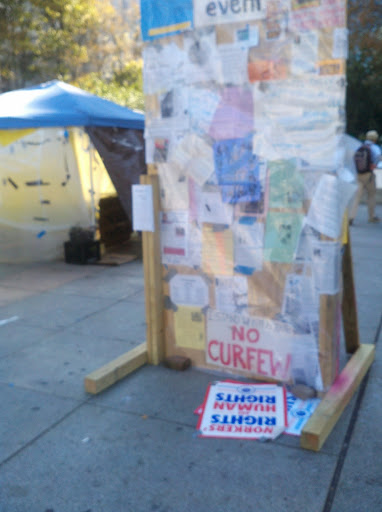
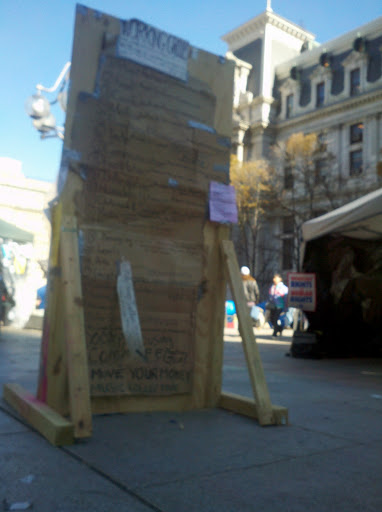
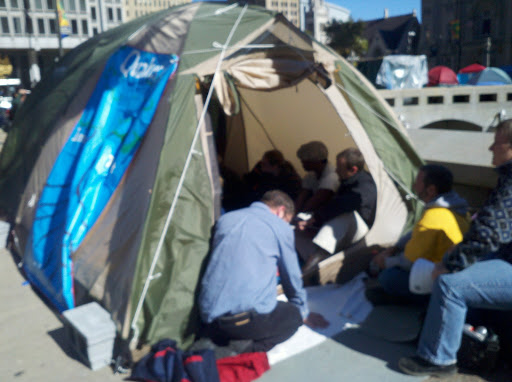
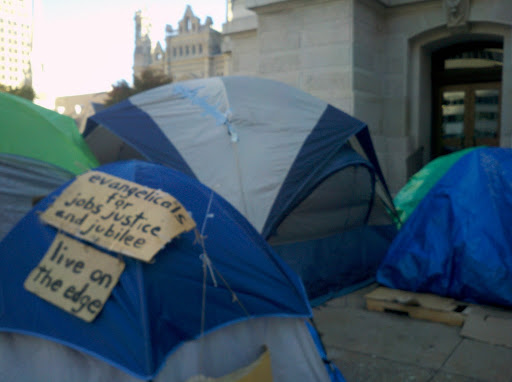
The offices of Friends General Conference are across the street from the Pennsylvania Convention Center, which is this week hosting a biotech convention. The streets outside are hosting a bit of a counter-convention led by a group named “BioDemocracy 2005”:http://www.biodev.org/. Here are some shots from a melee outside our front door a few minutes ago.
*Update:* apparently one of the police officers at the center of this scuffle “suffered a heart attack and has since died”:http://www.philly.com/mld/philly/business/special_packages/bio2005/11949070.htm. I’m not even sure how to comment on that. From my vantage point it certainly seemed like the police officers were using undue violence. But while I was ten feet away I don’t know who threw the first punch and what exactly happened in that sea of bodies. Whatever happened, it’s quite appropriate to hold him and his family in our prayers.
A few years ago I felt led to take up the ancient Quaker testimony of plain dressing. I’ve spoken elsewhere about my motivations but I want to give a little practical advice to other men who have heard or even gotten ahold of the “Gohn Bros.” catalog but don’t know just what to order. I certainly am not sanctioning a uniform for plain dress, I simply want to give those so inclined an idea of how to start.
Just as background: I’m a thirty-something Philadelphia native, brought up without any formal religion in a Philly suburb. I first started approaching Quakers (Friends) back in college. In my early twenties, I started working at a collectively-run pacifist book publishing house and living in what was then the sort of downscale hipster neighborhood of West Philadelphia. In 2002 I attended a week-long workshop that had some plain dressing Friends and felt the nudge to experiment. I’ve left Philadelphia to become a resident of a small farming town in South Jersey (what love will do) but I still spend a lot of time in the city and in decidedly urban settings. I don’t aim to be historically correct with my plain dress and I don’t want to simply “look like an Amish” person.
Gohn Brothers is a store in Indiana that sells “Amish and Plain Clothing.” It is currently celebrating it’s 100th year in business. It’s known for it’s simple print catalog, which is updated every few months. It does not have a website. You should get a copy of the catalog to get current clothing and shipping prices. It’s address is:
PO Box 1110, 105 S. Main St., Middlebury IN 46540
Phone: (574) 825‑2400. Toll-free: 800 – 595-0031
When I first started “going plain,” I simply wore regular dark pants with suspenders found at a generic department store. It was important to me that I was wearing clothes I already had, and I wanted to be “Sears Plain,” by which I meant I didn’t want to go to any extremes to find plain clothing. When I first bought a pair of broadfalls (the zipperless pants favored by plain men), I didn’t wear them for months. Slowly I started started wearing them out and feeling more at ease in them. They were made of rugged denim, wore well and were quite comfortable.
As my pre-plain clothes have worn out, I’ve started replacing them with Gohn Brothers-produced broadfalls. They’re just as inexpensive as any cheaply-made jeans from Old Navy but they hold up and are presumably made in Indiana by seamstresses earning a decent wage.
Broadfalls
Gohn Brothers offers many different weights and fabrics for their broadfall pants, numbering them for ease of ordering. I have bought two pair, both of which I like:
Coats
Gohn Brothers produces a number of coats, also called “overshirts.” In these purchases I have tended to be more distinctly Quaker. I have two Coats:
I’ve prefered the specialized “regular cut” coat over the standard “full cut.” The regular cut feels more like the standard suit jacket that most professional men wear to work, while the full cut felt more like a wind-breaker. I also prefer the buttons, as the snaps contributed to the wind-breaker feel.
Suspenders
Also known as “braces,” all you need are dark broadfalls and suspenders to really look “plain” to the world. “Tabbed” suspenders fit over buttons in your pants, while “clip-on’s” use alligator clips to fasten onto standard pants. Tabbed look better but I can’t help thinking of Michael Douglass in “Wall Street”; a lot of ordinary anabapist men I see have clip-on’s.
I’ve heard the story that there’s a good-hearted ribbing between the Iowa and North Carolina Conservative Quakers about whether thin or wide suspenders is more plain. I’ve started to throw my lot in with Iowa and have gotten the three-quarter inch suspenders. (Fashionistas will remember that thin suspenders were popular with a certain kind of high school geek in the mid-1980s – think Cameron in Ferris Beuler’s Day Off; fair disclosure requires that I admit that I wore them around Cheltenham High). Again Gohn Brothers:
Hats
While Gohn Brothers does hats, I haven’t bought any of theirs. Instead I’ve gone for the Tilley T3 hat. I’m not complete happy with this, as Tilley’s seem to be associated with a certain kind of clueless traveler, but I’ve noticed that there are a lot of men in my yearly meeting who wear them, I think as an unconscious nod toward plainness. The Tilley is also friendlier to bike commuters: its tie-down strings wrap easily around bike handlebars, and it’s very crushable and washable.
Not a Uniform
Again, let me stress: I am not trying to specify a modern plain dress uniform. The only time you should adopt plain dress is when you’re feeling actively led by it. Sometimes that leading is an intution, which is fine, but you need to follow it on your own terms. My practice has evolved over time and yours should too. I’ve become more plain since I started this witness simply because I had to replace worn clothes and couldn’t see spending more money for shoddier clothes than I could get at Gohn Brothers. You don’t need to get broadfalls to be “plain,” as “plainness” is as much a state of mind and an attitude toward God and your spiritual community as it a set of clothes. I think of it now as a spiritual discipline, one very fitting for our consumeristic times.
I’d love to hear from others about their plain dressing.
The other day I had lunch with an old friend of mine, a thirty-something Quaker very involved in nation-wide pacifist organizing. I had lost touch with him after he entered a federal jail for participating in a Plowshares action but he’s been out for a few years and is now living in Philly.
We talked about a lot of stuff over lunch, some of it just movement gossip. But we also talked about spirituality. He has left the Society of Friends and has become re-involved in his parents’ religious traditions. It didn’t sound like this decision had to do with any new religious revelation that involved a shift of theology. He simply became frustrated at the lack of Quaker seriousness.
It’s a different kind of frustration than the one I feel but I wonder if it’s not all connected. He was drawn to Friends because of their mysticism and their passion for nonviolent social change. It was this combination that has helped power his social action witness over the years. It would seem like his serious, faithful work would be just what Friends would like to see in their thirty-something members but alas, it’s not so. He didn’t feel supported in his Plowshares action by his Meeting.
He concluded that the Friends in his Meeting didn’t think the Peace Testimony could actually inspire us to be so bold. He said two of his Quaker heroes were John Woolman and Mary Dyer but realized that the passion of witness that drove them wasn’t appreciated by today’s peace and social concerns committees. The radical mysticism that is supposed to drive Friends’ practice and actions have been replaced by a blandness that felt threatened by someone who could choose to spend years in jail for his witness.
I can relate to his disappointment. I worry about what kinds of actions are being done in the name of the Peace Testimony, which has lost most of its historic meaning and power among contemporary Friends. It’s invoked most often now by secularized, safe committees that use a rationalist approach to their decision-making, meant to appeal to others (including non-Friends) based solely on the merits of the arguments. NPR activism, you might say. Religion isn’t brought up, except in the rather weak formulations that Friends are “a community of faith” or believe there is “that of God in everyone” (whatever these phrases mean). That we are led to act based on instructions from the Holy Spirit directly is too off the deep end for many Friends, yet the peace testimony is fundamentally a testimony to our faith in God’s power over humanity, our surrender to the will of Christ entering our hearts with instructions which demand our obedience.
But back to my friend, the ex-Friend. I feel like he’s just another eroded-away grain of sand in the delta of Quaker decline. He’s yet another Friend that Quakerism can’t afford to loose, but which Quakerism has lost. No one’s mourning the fact that he’s lost, no one has barely noticed. Knowing Friends, the few that have noticed have probably not spent any time reaching out to him to ask why or see if things could change and they probably defend their inaction with self-congratulatory pap about how Friends don’t proselytize and look how liberal we are that we say nothing when Friends leave.
God!, this is terrible. I know of DOZENS of friends in my generation who have drifted away from or decisively left the Society of Friends because it wasn’t fulfilling its promise or its hype. No one in leadership positions in Quakerism is talking about this lost generation. I know of very few thirty-something Friends who are involved nowadays and very very few of them are the kind of passionate, mystical, obedient-to-the-Spirit servants that Quakerism needs to bring some life back into it. A whole generation is lost – my fellow thirty-somethings – and now I see the passionate twenty-somethings I know starting to leave. Yet this exodus is one-by-one and goes largely unremarked and unnoticed (but then I’ve already posted about this: It will be in decline our entire lives).
Update 10/2005
I feel like I should add an addendum to all this. As I’ve spoken with more Friends of all generations, I’ve noticed that the attention to younger Friends is cyclical. There’s a thirty-year cycle of snubbing younger Friends (by which I mean Friends under 40). Back in the 1970s, all twenty-year-old with a pulse could get recognition and support from Quaker meetings; I know a lot of Friends of that generation who were given tremendous opportunities despite little experience. A decade later the doors had started to close but a hard-working faithful Friend in their early twenties could still be recognized. By the time my generation came along, you could be a whirlwind of great ideas and energy and still be shut out of all opportunities to serve the Religious Society of Friends.
The good news is that I think things are starting to change. There’s still a long way to go but a thaw is upon us. In some ways this is inevitable: much of the current leadership of Quaker institutions is retiring. Even more, I think they’re starting to realize it. There are problems, most notably tokenism — almost all of the younger Friends being lifted up now are the children of prominent “committee Friends.” The biggest problem is that a few dozen years of lax religious education and “roll your own Quakerism” means that many of the members of the younger generation can’t even be considered spiritual Quakers. Our meetinghouses are seen as a place to meet other cool, progressive young hipsters, while spirituality is sought from other sources. We’re going to be spending decades untangling all this and we’re not going to have the seasoned Friends of my generation to help bridge the gaps.
Related Reading