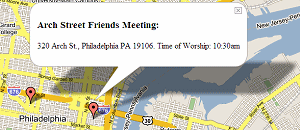
 To the best of my knowledge this is the first Quaker Google Maps hack, showing the meetinghouses of downtown Philadelphia. Click on the thumbtacks for details; click on the satellite view for a cool view! Like much of the web it looks much better in “Firefox”:http://www.mozilla.org/products/firefox/. Hack courtesy of the extremely experimental “MyGmaps”:http://mygmaps.com, data from “Quakerfinder.org”:www.Quakerfinder.org. Here’s my short list of “Google Map Hacks”:http://del.icio.us/martin_kelley/map.
Although I love Quakerfinder, it should be noted that Google does almost as good a job listing area “Friends Meetings” via their “local search” feature.
Quaker Ranter
A Weekly Newsletter and Blog from Martin Kelley
Tag Archives ⇒ Quaker
Witness of Our Lost Twenty-Somethings
May 16, 2005
For those that might not have noticed, I have an article in the latest issue of the awkwardly-named FGConnections: “Witness of Our Lost Twenty-Somethings.” Astute Quaker Ranter readers will recognize it as a re-hashing of “The Lost Quaker Generation” and its related pieces. Reaction has been quite interesting, with a lot of older Friends saying they relate to what I’ve said. It’s funny how so many of us feel a sense of isolation from our own religious institutions!
The Witness of Our Lost Twenty-Somethings
By Martin Kelley
What is it like to be a thirty-something Friend these days? Lonely and frustrating. At least half of the committed, interesting and bold twenty-something Friends I knew ten years ago have left Quakerism. This isn’t normal youthful church-hopping and it’s not some character flaw of “Generation X.” They’ve left because they were simply tired of slamming their heads against the wall of an institutional Quakerism that neglected them and its own future.
I can certainly relate. For the last decade, I’ve done ground-breaking work publicizing nonviolence online. I’ve been profiled in the New York Times and invited on national talk radio shows, but the clerk of the peace committee in my achingly-small monthly meeting always forgets that I have “some website” and I’ve never been asked to speak to Friends about my work. I wouldn’t mind being overlooked if I saw others my age being recognized, but most of the amazing ministries I’ve known have been just as invisible.
It’s like this even at the small-scale level. I’ve gone to countless committee meetings with ideas, enthusiasm and faithfulness, only to realize (too late, usually) that these are just the qualities these committees don’t want. Through repeated heartbreak I’ve finally learned that if I feel like I’m crashing a party when I try to get involved with some Quaker cause, then it’s a sign that it’s time to get out of there! I’ve been in so many meetinghouses where I’ve been the only person within ten years of my age in either direction that I’m genuinely startled when I’m in a roomful of twenty- and thirty-somethings.
I recently had lunch with one of the thirtysomething Friends who have left. He had been drawn to Friends because of their mysticism and their passion for nonviolent social change; he was still very committed to both. But after organizing actions for years, he concluded that the Friends in his meeting didn’t think the peace testimony could actually inspire us to a witness that was so bold.
I wrote about this lunch conversation on my website and before long another old Friend surfaced. Eight years ago a witness and action conference inspired him to help launch a national Quaker youth volunteer network. He put years of his life into this; his statements on the problems and promises facing Quaker youth are still right on the mark. But after early excitement his support evaporated and the project eventually fell apart in what he’s described as “a bitter and unsuccessful experience.”
The loss of Quaker peers has hit close to home for me. When one close Friend learned my wife had left Quakerism for another church after eleven years, all he could say was how pleased he was that she had finally found her spiritual home; others gave similar empty- sounding platitudes. I felt like saying to them “No, you dimwits, we’ve driven away yet another Friend!” Each of these three lost Friends remain deeply committed to the Spirit and are now involved in other religious societies.
Young adults haven’t always been as invisible or uninvolved as they are now. A whole group of the Quaker leaders currently in their fifties and sixties were given important jobs at Quaker organizations at very tender ages (often right out of college). Also, there’s historical precedent for this: George Fox was 24 when he began his public ministry; Samuel Bownas was 20 when he was roused out of his meetinghouse slumber to begin his remarkable ministry; even Margaret Fell was still in her thirties when she was convinced. When the first generation of Friends drew together a group of their most important elders and ministers to address one of their many crises, the average age of the gathering was 35. Younger Friends haven’t always been ghettoized into Young
Audlt Friends only dorms, programs, workshops or committees.
There is hope. Some have started noticing that young Friends who go into leadership training programs often disappear soon afterwards. The powers that be at Friends General Conference have finally started talking about “youth ministry.” (Welcome!). A great people might possibly be gathered from the emergent church movement and the internet is full of amazing conversations from new Friends and seekers. There are pockets in our branch of Quakerism where older Friends have continued to mentor and encourage meaningful and integrated youth leadership, and some of my peers have hung on with me. Most hopefully, there’s a whole new generation of twenty- something Friends on the scene with strong gifts that could be nurtured and harnessed.
In the truest reality, our chronological ages melt away in the ever-refreshing currents of the Living Spirit; we are all as children to a loving God. Will Friends come together to remember this before our religious society loses another generation?
Friends Familiar with My Struggles
May 5, 2005
A Guest Piece from ‘Quakerspeak’ C. Reddy.
On April 23 I flew to Oregon to serve on an editorial board for a book that QUIP is putting together of young Friends’ experiences of Quakerism. After arriving in Oregon but before I met with the editorial board for this, I served on a panel with the other young Friends on the editorial board in a QUIP meeting (as we had arrived at the end of a QUIP conference for our meeting) about how media, printed or otherwise, inspired us spiritually. As we related our experiences as young Friends (and growing up as Quakers), a number of issues surfaced rather quickly.
As young Friends move through high school and enter the [young] adult world, there is often a general lack of communication between young Friends and adults in Meetings, as if there’s some tension about it. Personally, as a young Friend in Durham Friends Meeting (NCYM(Cons.)), I’ve found that I know certain adults — ones with whom I have interacted more specifically over the years as I have grown up. Often these are parents of other young Friends in the Meeting or people who have been involved in youth group events. What’s missing is the connection to the rest of the adults in Meeting; I’ve been attending Durham Friends Meeting since I was born (with a period during middle school where I was mostly absent, but for the last few years I’ve been quite regular in attendance) and I feel like most of the meeting has no idea who I am. In addition to that, I’ve not known how to communicate my involvement and dedication in various national Quaker communities, such as being chosen as one of six co-clerks of the HS program at FGC Gathering this summer, my participation in Young Quakes, my attendance at a Pendle Hill Clerking workshop last fall, my involvement in this QUIP book, or how I have been reading many Quaker books over the last few months, all of which have been VERY integral in my spiritual development. Even Friends in Durham Friends Meeting with whom I do converse sometimes after Meeting do not know of all these things with which I am involved.
Also, when I stopped attending First Day school in January of my junior year in high school (a little over a year ago) and began attending the full hour of Worship, I spoke to two youth leaders about it briefly so they would understand, and then there was no further response. Looking back on this, I feel that the Meeting should be more involved in such a transition for all young Friends — not just those adults directly involved in the youth group/First Day school, but everyone should be more aware and attentive of the young Friends in Meeting and their involvement in Quaker communities outside of Meeting.
One thing that each of us felt is very important yet very lacking is mentorship within Meeting for Worship. There need to be adults who are not necessarily First Day school teachers, youth group leaders, or parents who are willing to have a relationship with a young Friend as someone who has had more experience with Quakerism and can nurture a young Friend’s spiritual development. A young Friend who was in Oregon with me related her experiences with a mentor she has at Earlham (she is a second-year there, currently), and how she sees him about once a week; often she even receives books to read from him.
As the only active young Friend at my school (I’m sort of the ‘token’ Quaker around), I usually do not have anyone to talk to about my spiritual findings and leadings. As I have continued to develop spiritually, I find more and more I need other Friends to talk who are familiar with my struggles.
These are issues not only within Durham Friends Meeting, but in Meetings across the country. I recognize that there are efforts to improve youth programs everywhere, but it never hurts to start locally.
As a graduating senior this year, and as an involved Friend, I would like to improve my relationship with the Meeting as a whole and make way for better relationships between members and young Friends in the future. This, however, needs to be fully a double-sided effort.
Jeffrey Hipp: My Feet Are on Solid Ground
May 2, 2005
A Guest Piece by Jeffrey Hipp
“I take this commitment of membership very seriously – to labor, nurture, support and challenge my fellow Friends; to walk in the Light together, and to give, receive, and pray with my fellow sojourners when the next step is unclear. My feet are on solid ground.”
Net Sightings
May 2, 2005
The Public Quaker writing about prayer
bq. Prayer is one constant thing for me, a reliable base. When am I having epistemological doubt about everything, I do know that is good for me to pray.
A month ago LizOpp posted a interest “FAQ on her worship group”:http://thegoodraisedup.blogspot.com/2005/03/faqs-about-my-worship-group.html which is well worth reading. Last week she followed it up with a very chew-worthy post on “Theological unity and spiritual diversity”:http://thegoodraisedup.blogspot.com/2005/04/theological-unity-and-spiritual.html (which adds new ground to the territory we’ve been exploring here on Quaker Ranter on “Non-Theism”:http://www.nonviolence.org/martink/archives/000567.php and “Loving God”:http://www.nonviolence.org/martink/archives/000577.php).
“Quakerspeak”:http://www.livejournal.com/users/Quakerspeak/ is the new blog by a high-school Friend I met last week in Oregon. Whew, is she on fire!:
bq. I never really thought much about how I was sort of bottling up all my theological and spiritual contemplations; suddenly I feel like I’m pouring it all out on the table and examining it all.. well, except that I’ve been examining it all. I’m trying to better apply my sprituality to my daily life and interactions without losing sight of myself; I’m trying to figure out where it all fits into my own life without trying to alter my personality or ways of being.
Beppe’s just started a new series with a post, “The Troubles with Friends Part 1”:http://beppeblog.blogspot.com/2005/05/trouble-with-friends-1-too-much-of.html. This first installment focuses on our fear of judgementalism. Speak on, bro!
Youth Ministries 2: What Do Young Friends Want?
April 28, 2005
I was given permission to pass along this data from the FGC-sponsored Youth Ministry Consultation that took place Third Month. A number of goals and projects had been brainstormed beforehand. The thirty-or-so participants at the Consultation were each given ten stars, which they were asked to put next to the projects they thought should be pursued. Every star acted as a vote that there was one person interested in that topic. The stars were coded to indicate the age range of the voter: High-Schooler, Adult Young Friend (18 – 37 years old) and older Friends.
 |
| One of the “stars” charts at the consultation |
Being the information design geek, I converted the resultant votes to into qualities and colors and put them into a chart showing interest level. Projects that received no votes from a particular age range are labeled “none,” for no interest; 2 – 3 stars is “weak” interest and so forth, up to “HOT” which are projects which received over 7 stars from an age group.
As an example, take “develop spirituality.” Seven adult young Friends (aged 18 – 37) put a star down for this, indicating they thought it was something FGC should promote, hence “strong” (bright red) interest from this age group. No Friend over forty used one of their stars to indicate interest in this work, indicating that none of them thought FGC should be promoting spiritual development. Here are the results:
| High-School Voters | YAF Voters | Older Adult Voters | |||||||
Expecially for Adult Young Friends | |||||||||
| Community | weak | strong | weak | ||||||
| Develop spirituality | none | strong | none | ||||||
| Outreach & how to explain our faith | none | strong | weak | ||||||
| Critical mass at MM, QM, YM | none | weak | strong | ||||||
| Mentoring by older Friends | none | strong | none | ||||||
| Mentoring to younger Friends | none | strong | none | ||||||
| Mentoring to older Friends: | none | strong | none | ||||||
| Help with transitions | none | *HOT* | weak | ||||||
| Advertising programs | none | weak | none | ||||||
| Suggestions: | |||||||||
| Traveling Ministries for AYF | none | lukew | weak | ||||||
| Groups throughout the year for support | none | lukew | weak | ||||||
| Support for AYF groups at the YM levels | none | weak | weak | ||||||
| Database to help isolated friends | none | none | none | ||||||
| Clearness/discernment process: | |||||||||
| For HS to College | none | lukew | none | ||||||
| For work transitions | none | weak | none | ||||||
| For relationships | none | weak | none | ||||||
| For parenthood | none | weak | weak | ||||||
| Intergenerational Spiritual Conversations | |||||||||
| About Vital Friends Issues | none | lukew | none | ||||||
| Vision of Quakerism in 50 years | none | lukew | weak | ||||||
| Financial support for AYF | weak | *HOT* | lukew | ||||||
| Retreats for youth workers | none | none | weak | ||||||
| Materials specifically designed for AYF, | none | none | none | ||||||
| General Questions: | |||||||||
| How do we handle the broad age span? | none | weak | none | ||||||
| How do we tap the energy and passion of this group MMs, YMs & FGC? | none | lukew | strong | ||||||
| How do we meet the needs without separating AYF from larger community? | none | lukew | none | ||||||
| How do we sustain community when we only meet once a year? | none | lukew | weak | ||||||
Especially for High Schoolers | |||||||||
| Needs: | |||||||||
| Adults who are better prepared to work with them… | weak | lukew | strong | ||||||
| FAP�s that have self confidence | none | none | weak | ||||||
| Help with discernment process around college | none | none | none | ||||||
| Help with disc: C‑O | none | none | weak | ||||||
| Help with discernment around life choices | none | none | weak | ||||||
| Discernment questions: #3, #4, & #5: | none | weak | strong | ||||||
| Building community | weak | weak | weak | ||||||
| Networking | weak | none | none | ||||||
| Bible study, RE curriculum | none | none | weak | ||||||
| Training how one person can have impact | none | none | none | ||||||
| Training on how to develop group dialogs | weak | none | weak | ||||||
| Help to get more teens involved | weak | none | lukew | ||||||
| Programming help | none | none | none | ||||||
| Leadership Development | weak | weak | weak | ||||||
| Suggestions: | |||||||||
| Youth newsletter | lukew | weak | none | ||||||
| Email forum | lukew | weak | none | ||||||
| Email data base | none | weak | none | ||||||
| Event b’ween Young Quakes and Gathering | weak | none | none | ||||||
| Youth exchange | weak | none | none | ||||||
| Programs to facilitate rites of passage | weak | none | none | ||||||
Things Younger Friends wanted more than Older Friends:
In order by AYF popularity:
- MENTORSHIP: The AYFs really want cross-generational mentoring relationships. When the questions were first posed, there only “mentoring by older Friends” and “mentoring to younger Friends.” Check the math and you’ll see that’s the same question (whoever put the questions together forgot that the Quaker understanding of eldership is not necessarily a function of age, hmm). I grabbed a pencil and added “mentoring to older Friends” and it was instantly popular. Even though the mentorship issue was spread over three questions, AYF’s voted “strongly” for each of them, showing terrific popular support. Almost no over-40 Friend voted for this. This is not something that can be forced onto disinterested older Friends, which means I think we young-in’s are going to have to rely on one another for mentorship.
- SUPPORT FOR AYF CONFERNCES: Younger Friends want to spend more time together. Note should be made that the voters were Friends attending a conference and that we were a selected and self-selected group who presumably like to attend conferences. Still, this is popular.
- TALKING ABOUT OUR FAITH: It’s sad that only two older Friends thought explaining the faith was worthwhile. At the same time it’s encouraging that 13 AYFs wanted this. It’s very clear that younger Friends aren’t as afraid of talking about serious faith issues as the Baby Boomers (it’s nice to see some of my essays confirmed!).
Things Older Friends wanted more than Younger Friends:
- TAPPING THE YOUTH: There was what I thought was a semi-obnoxious question about how to “tap the energy and passion” of younger Friends. This is very close to the all-too-common generational mindset that sees “values young people as a resource” (as a ad in heavy-rotation at NPR proclaims). We are not a resource for extraction. Young people are too often seen merely as a source of cheap labor for projects initiated, designed and run by older Friends; they are wanted as passive audience members for older Friends’ pontificating lectures; they are endlessly proclaimed a far-off “future” of Friends rather than the very much here-and-now present of Friends.While older Friends at the consultation felt strongly that young people should be tapped, Adult Young Friends had lukewarm interest in being tapped and high school Friends showed no interest whatsoever. While not all older Friends think of young Friends as “resources,” it’s a common-enough theme that we need to flag it as a part of the generational gap. I suspect that power issues will surface when Quaker institutions try to pull together projects that “tap” youth: twenty-something Friends are going to want more involvement in the design and operation of these projects than older Friends will be willing to give.Similarly, older Friends seem to be more interested that younger Friends attain “critical mass” at Quaker institutions like monthly, quarterly and yearly meetings. The phrasing of the question is a little ambiguous and I see two likely explanations. One is that younger Friends don’t feel they need critical mass to be involved in Quaker institutions and want integrated intergenerational participation rather than “AYF ghettos.” The other possibility (the scarier one) is that younger Friends simply aren’t as committed to Quaker institutions. I suspect the generational differences in responses are the result of both these factors, plus others perhaps.
Things no one particularly cared about:
- No one wants materials specifically designed for AYF. No one wants advertising programs. No one wants a database to help isolated Friends.
- An AYF traveling ministries was lukewarm, 4 YAF stars, 3 over-40. This surprises me.
- Any other patterns that should be lifted up?
Disclaimer
I should note that this was not a scientific survey. Though the organizers of the Consultation tried hard and the participants were surprisingly diverse for an collection like this, they weren’t representative. There were only four high school participants and I didn’t adjust their votes: “lukewarm” support from them should really be relabled “strong” support.
While this is a small sample size, this is one of the few recent surveys of it type in FGC Quakerism and it bears close study. It confirms a lot of what I’ve been saying all these years (yea!, I’m not crazy) and echoes what I hear a lot of high school and twenty-something Friends talking about. Take it for what its worth!
Related:
- I first wrote about the Youth Ministries Consulation in “It’s My Language Now”
What’s God Got to Do, Got to Do With It?
April 18, 2005
This essay is my hesitant attempt to answer the questions James R. posted a few weeks ago, I Am What I Am.
Loving God with All Our Hearts
My religion teaches me that the first commandment is to love God above all else. The primary mission of a religious community is to serve God and to facilitate the spiritual growth and discernment of its members in their search for God. For me, this needs to be an explicit goal of my meeting.
I very much appreciate James’s honesty that for him to use the term of “God” would be “misleading, even dishonest.” One of the central openings of Quakerism is that we should not profess an abstract understanding of God. We believe in the necessity for “deep and repeated baptisms” and for every testimony and act in the ministry to come from the “immediate influence of his Spirit” in a “fresh annointing” (wonderful language from a Irish memorial minute for Job Scott). I would wish that more Friends would follow James’s example and not speak without that immediate direct knowledge of the divine. (How many plenary speakers at Quaker events are reading from a prepared speech? How many of us really find ourselves turning to prayer when conflicts arise in business meeting?)
I don’t think one does need an experience of God to be a part of a Quaker community. Many of us go through dry spells where the Spirit’s presence seems absent and this certainly doesn’t disqualify us for membership. But God is the center of our faith and our work: worship is about listening to God’s call; business meeting is about discerning God’s instructions. This has to be understood. For those who can’t name God in their lives, it must be just a bit bizarre to come week after week to participate with a group of people praying for God’s guidance. But that’s okay. I think all that is good in our religious society come from the Great Master. We are known by our fruits and the outward forms of our witnesses constantly point back to God’s love. This is the only real outreach we do. I’m happy spending a lifetime laboring with someone in my community pointing out to the Spirit’s presence in our midst. All that we love about Quakers comes from that source but part of my discipline is the patience to wait for God to reveal Herself to you.
I joined Friends via the fairly common route of peace activism. I could sense that there was something else at work among the Quaker peace activists I knew and wanted to taste of that something myself. It’s taken me years to be able to name and articulate the divine presence I sensed fifteen years ago. That’s okay, it’s a normal route for some of us.
The other piece that the comments have been dancing around is Jesus. I’m at the point where I can (finally) affirm that Christianity is not accidental to Quakerism. As I’ve delved deeper I’ve realized just how much of our faith and work really does grow out of the teachings of Jesus. I don’t want to be part of a Friends meeting where our Quaker roots are largely absent. I want to know more about Friends, which means delving ever deeper into our past and engaging with it. We can’t do that without frequently turning to the Bible. Liberal Friends need to start exploring our Christian roots more fully and need to get more serious about reading Quaker writings that predate 1950. There have been many great figures in human history, but whatever you think about the divinity of Jesus, he has had much more of an impact on Quakerism than all of the heroes of American liberalism combined. We’ve got a Friend in Jesus and we’ve got to get on speaking arragements with him again if we’re going to keep this Quakerism going.
Shaking the Sandy Foundation
James asked if the regulars at Quaker Ranter wanted a purging. I certainly don’t want to kick anyone out but I don’t think some of the people currently involved in Quakerism would be with us if we were truer to our calling. We need to start talking honestly and have a round or two of truth-telling and plain speaking about what it means to be a Friend. Yes, there are some delicate people who are offended by terms like God and worship, Christ and obedience. And many have good reasons to be offended (as Julie pointed out to me this weekend, one of the greatest sins our religious and political leaders have done over the centuries is to commit evil in the name of God, for they not only committed that evil but have so scarred some seekers that they cannot come to God). One can know Jesus without using the name and God does hold us in His warm embrace even through our doubts. But for those of us lucky enough to know His name shouldn’t be afraid to use it.
Many people come to us sincerely as seekers, trying to understand the source of Quakers’ witness and spiritual grounding. I appreciate James’s asking “why I feel so irrestibly drawn to a community and religious society in which the central term is God.” As long as that’s where we start, I’m happy to be in fellowship.
But fellowship is an immediate relationship that doesn’t always last. There are people involved in Quakerism for reasons that are incidental to the mission of our religious society. We know the types: peace activists who seem to be around because Quakers have a good mailing list; Friends from ancient Quaker families who are around because they want to be buried out with great-grandma in the cemetery out back; twenty-something liberal seekers who like the openness and affability of Quakers. These are sandy foundations for religious faith and they will not necessarily hold. If Quakers started articulating our beliefs and recommitting ourselves to be a people of God, we will have those who will decide to drift away. They might be hurt when they realize their attraction to Quakerism was misplaced.
Naming the Trolls
We’ve all met people who have walked into a meetinghouse with serious disagreements with basic fundamental principles of Quakerism. This is to say we attract some loonies, or more precisely: visitors who have come to pick a fight. Most religious institutions show them the door. As Friends we have a proud tradition of tolerance but we’re too quick nowadays to let tolerance trump gospel order and destroy the “safe space” of our meetinghouse. This is a disservice to our community. Every so often we get someone who stands up to angrily denounce Christian language in a Quaker meeting. It’s fine to challenge an in-group’s unexamined pieties but I’m talking about those who try to get the meeting to censor ideas by claiming victimhood status whenever they hear a Christian worldview expressed. The person’s motivations for being there need to be questioned and they need to be lovingly labored with. We attract some people who deeply hurt and come with axes to grind. Some of them will use non-theism as their rallying call. When they are eldered they will claim it’s because of their philosophy, not their action. These kind of conflicts are messy, unpleasant and often confusing but we need to address them head on.
There are plenty of professing Christians who also need to be called on their disruptive behavior. They too would claim that any eldership is a reaction to their Christian theology. (Actually, I know more professing Christians than professing non-theists who should be challenged this way (Julie asked “who?” and I came up with a list of three right off the bat)). But there are disrupters of all flavors who will trumpet their martyrdom when Friends finally begin to take seriously the problems of detraction (a fine Quaker concept we need to revisit). If we suffer unfairly we need to be able to muster up a certain humility and obedience to the meeting, even if we’re sure it’s wrong. Again, it will be messy and all too-human but we need to work with each other on this one.
Sharing the Treasure
The real problem as I see it is not respectful non-theists among us: it’s those of us who have tasted of the bounty but hoard the treasure for ourselves. We hide the openings we’ve been given. A few weeks ago I was at yearly meeting sessions attended by some of the most recognized ministers in Philadelphia when a woman said she was offended by the (fairly tame) psalms we were asked to read. She explained “I’m used to Quakerese, Light and all that, and I don’t like all this language about God as an entity.” No one in that room stood to explain that these psalms _are one of the sources_ of our Quakerese and that the “Light” Friends have have been talking about for most of the past three and a half centuries is explicitly the Light _of Christ_. I don’t want to make too big a deal of this incident, but this kind of thing happens all the time: we censor our language to the point where it’s full of inoffensive double-meanings. Let’s not be afraid to talk in the language we have. We need to share the treasure we’ve been given.
Related Reading:
This post was inspired by James R’s comment, which I titled I Am What I Am. He was responding originally to my essay We’re All Ranters Now. I remain deeply grateful that James posted his comment and then allowed me to feature it. These are not easy issues, certainly not, and its easy to misread what we all are saying. I hope that what I’m contributing is seen through the lens of love and charity, in whose spirit I’ve been trying to respond. I’m not trying to write a position paper, but to share honestly what I’ve seen and the openings I feel I have been given – I reserve the right to change my opinions! From what I’ve read, I’d be honored to be in fellowship with James.
Liz Oppenheimer has opened up with a thoughtful, tender piece called My Friendly journey with Christ.
You know the disclaimer at the bottom that says I’m not speaking for any Quaker organization? I mean it. I’m just take phone orders and crank out web pages for a particular organization. This isn’t them speaking.
The Loss of a Faithful Servant
April 18, 2005
A humble giant among modern Friends passed away this weekend: Bill Taber. All of us doing the work of mapping out a “conservative liberal Quakerism” owe a huge debt to Bill. Although others are more qualified to share his biography, I know he taught for many years at Ohio Yearly Meeting (Conservative)‘s Olney Friends School and then for many more years at the Pendle Hill Center outside Philadelphia. He and his wife Fran were instumental in the 1998 founding of the Friends Center retreat and conference center on the campus of Olney.
I had the honor of meeting Bill and Fran once, when they came to lead a meeting retreat. But like so many Friends, Bill’s strongest influence has been his writings. “Four Doors to Meeting for Worship”:http://www.Quakerbooks.org/get/0 – 87574-306 – 4 was his introduction to worship. I’ll quote from the “About the Author,” since it explains the root of much of his work:
bq. This pamphlet’s metaphor of the four doors grew out of his awarness of a need for a more contemporary explanation of “what happens” in a Quaker meeting. He feels this lack of insturction in method has become an increasing problem as modern Friends move farther and farther away from the more pervasive Quaker culture which in earlier generations played such a powerful teaching role, allowing both birthright and convinced Friends to learn the nuances and spiritual methodology of Quakerism largely through osmosis. In sharing this essay Bill hopes to help nurture a traveling, teaching, and prophetic ministry which could reach out and touch people into spiritual growth just when they are ready to receive the teaching.
One of the spiritual methodolgy’s Bill shared with his students at Pendle Hill was a collection by a old Quaker minister named Samuel Bownas – regular readers of this site know how important Bownas’s “Descriptions of the Qualifications”:http://dqc.esr.earlham.edu/toc/E19787374 has been to me. But other books of his have been invalable too: his history of Ohio Yearly Meeting shared the old culture of the yearly meeting with great stories and gentle insight.
Bill Taber might have passed from his earthly body Friday morning but the work he did in the world will continue. May we all have the grace to be as faithful to the Teacher as he was.