John Paul Stephens has asked if I could help compile a list of online tributes to our Tom Fox, the fallen Christian Peacemaker for FreetheCaptivesNow.org’sTom Fox Memorials page. I’ve started a list, now up on QuakerQuaker.org, that I’ll keep up for a few months. Any readers who know of something that should be included should either email me at martink-at-nonviolence-dot-org or tag it “for:martin_kelley” in Del.icio.us. Thanks. Here’s my list so far:
h3. See also:
* “FreetheCaptivesNow.org”:http://freethecaptivesnow.org/
* “Christian Peacemaker Watch”:http://www.quakerquaker.org/christian_peacemaker_teams/ over at Quakerquaker.org
* “My posts on the Christian Peacemaker witness”:/martink/cpt
* “A really nice page on Tom over at Electronic Iraq”:http://electroniciraq.net/news/2302.shtml
Quaker Ranter
A Weekly Newsletter and Blog from Martin Kelley
Tag Archives ⇒ email
QuakerQuaker.org, new home to the blog watch
January 3, 2006
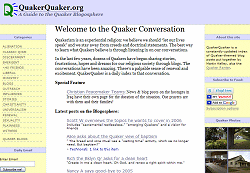 I’ve moved the Quaker Blog Watch material to a new website, QuakerQuaker.org. It’s more-or-less the same material with more-or-less the same design but the project has become popular enough that it seems like a good time to send it off on its own. I hope to find ways of making it more collaborative in the near-future.
You can subscribe to the QuakerQuaker Watch via Bloglines or to the daily email by following the links. If you’re already following the Watch in a subscription reader, you should change the source of the feed to http://feeds.quakerquaker.org/quaker if you don’t want to miss out on any future innovations. If you have the Watch currently listed in your blog’s sidebar you won’t have to change anything.
At some point when the dust of the move has settled (and I have the new Quakerfinder.org launched as part of my FGC work), I’ll take a moment to wax philosophical about the evolution of this project and will toss out a few ideas about where it might go in the future. In the meantime, let me know if anything is broken, confused or grammatically mangled.
A kind of retrospective history of the project is available on the “quakerquaker thread”:http://www.nonviolence.org/martink/quakerquaker/ of the Ranter.
Pass the hummus, please, and by the way: are you a fed?
December 22, 2005
It seems that every day brings new revelations from mainstream media about governmental spying on Americans.
MS-NBC started the ball rolling on the 14th when they informed us that the Pentagon had a database of “protesters including the Raging Grannies and a dozen or so Quakers in Florida”:http://www.msnbc.msn.com/id/10454316. This must have prompted the New York Times to publish a story they had been sitting on for a year: the scoop that Bush had ordered the super-secret “National Security Agency to start evesdropping on Americans”:http://www.nytimes.com/2005/12/15/politics/15cnd-program.html following the 9/11 terror attacks. It’s revelation was an FBI agent’s email complaining about “radical militant librarians [who] kick us around”:http://www.ala.org/al_onlineTemplate.cfm?Section=alonline&template=/ContentManagement/ContentDisplay.cfm&ContentID=111469. Two days later we received the almost-humorous news that the Department of Homeland Security was hard at work monitoring the “Massachusett’s inter-library loan system “:http://www.southcoasttoday.com/daily/12 [UPDATE: this has been “revealed to be a hoax”:http://www.southcoasttoday.com/daily/12 – 05/12 – 24-05/a01lo719.htm by the student]. Trying to outdo the DHS in ridiculous, we learned on the 20th that “the FBI has been infiltrating vegan potlucks”:http://www.nytimes.com/2005/12/20/politics/20fbi.html. Today it turns out the “New York City Police Department”:http://www.nytimes.com/2005/12/22/nyregion/22police.html has been doing its own extensive investigations into protesters. They even apparently staged mock arrests in an attempt to incite violence (their contribution to the self-parody has been to send officers undercover on bicycle protests).
Are we surprised by all this? Well, not really. The fears unleashed after 9/11 ignited a firestorm of paranoia in the ranks of spydom. Nonviolence.org got a call from the U.S. Secret Service when Osama bin Laden posted to the board that he wanted to kill President Bush (well, actually we’re pretty certain it was a acne-faced fourteen year old procrastinating on his geometry homework). When I shot “shot photos of a scuffle at a Biodemocracy protest a few months ago”:http://www.nonviolence.org/articles/2005/06/biodemocracy_pr.php a Philadelphia police detective was in my office an hour later wanting to see it (the “melee” was harmless except for a policeman with heart conditions who took that moment to have a heart attack).
While some monitoring and prudence is indeed necessary, what ties together the string of stories this week is the randomness of the targets. It’s as if the agencies had lost all sense of judgement. Anyone critical of the war (or even mainstream culture: witness the vegans) was considered a threat. All leads were investigated, no matter how silly.
While invading American’s privacy is upsetting and unwarranted, the greatest danger is the sheer mass of irrelevant information that’s been collected. What’s an agency to do with reams of data on bicycle riders and Quakers? Who’s watching the flight schools and fertilizer depots while Agent Nincompoop is trading hummus recipes with the cute vegan with the nosering?
Quaker Blog Watch by email
October 18, 2005
It started when I began bookmarking the more interesting Quaker posts I ran across over the course of the day. That turned into the sidebar on the “Quaker Ranter”:/martin homepage, which then turned into the “Quaker Blog Watch”:/quaker page. Now, as an experiment, I’m making it available as a daily email:
More info here: “Quaker Blog Watch by email”:http://www.nonviolence.org/quaker/email/
I do recognize that this site has mutliple fan bases. While I was on paternity leave a colleague emailed me to ask when I would post more pictures of Baby Francis. I looked and saw that it had only been ten hours since I had uploaded the last picture to my Flickr account. Aaayyee!, the danger of increasing expectations! Well, you can now get a daily email containing any new pictures of “Baby Francis”:/francis or “Big Kid Theo”:/theo: go to either of their homepages for the sign-up form (they share one subscription). One small step in self-indulgent parenthood, ain’t technology great?
The Early Blogging Days
June 17, 2005
I started Nonviolence.org in late 1995 as a place to publicize the work of the US peace movement which was not getting out to a wide (or a young) audience. I built and maintained the websites of a few dozen hosted groups (including the War Resisters League, Fellowship of Reconciliation and Pax Christi USA) but I quickly realized that the Nonviolence.org homepage itself could be used for more than just as a place to put links to member groups. I could use it to highlight the articles I thought should get more publicity, whether on or off the Nonviolence.org domain.
The homepage adapted into what is now a recognizable blog format on November 13, 1997 when I re-named the homepage “Nonviolence Web Upfront” and started posting links to interesting articles from Nonviolence.org member groups. In response to a comment the other day I wondered how that fit in with the evolution of blogging. I was shocked to learn from Wikipedia’s that the term “weblog” wasn’t coined until December of that year. I think is less a coincidence than a confirmation that many of us were trying to figure out a format for sharing the web with others.

The earliest edition stored on Archive.org is from December 4, 1997. It focused on the hundredth anniversary of the birth of Catholic Worker co-founder Dorothy Day. To give you an sense of the early independently-published articles, the January 2, 1998 edition included a guest piece by John Steitz, “Is the Nonviolence Web a Movement Half-Way House” that sounds eerily similar to recent discussions on Quaker Ranter.
Below is an excerpt from the email announcement for “Nonviolence Web Upfront” (typically for me, I sent it out after I had been running the new format for awhile):
NONVIOLENCE WEB NEWS, by Martin Kelley Week of December 29, 1997
CONTENTS
Introducing “Nonviolence Web Upfront”
New Procedures
New Website #1: SERPAJ
New Website #2: Stop the Cassini Flyby
Two Awards
Numbers Available Upon Request
Weekly Visitor CountsWith my travelling and holiday schedule, it’s been hard to keep regular NVWeb News updates coming along, but it’s been a great month and there’s a lot. I’m especially proud of the continuing evolution of what I’m now calling “Nonviolence Web Upfront,” seen by 1800 – 2200 people a month!
INTRODUCING “NONVIOLENCE WEB UPFRONT”
The new magazine format of the NVWeb’s homepage has been needing a name. It needed to mentioned the “Nonviolence Web” and I wanted it to imply that it was the site’s homepage (sometimes referred to as a “frontpage”) and that it contained material taken from the sites of the NVWeb.
So the name is “Nonviolence Web Upfront” and a trip to http://www.nonviolence.org will see that spelled out big on top of the weekly-updated articles.
There’s also an archive of the weekly installments found at the bottom of NVWeb Upfront. It’s quite a good collection already!
Now that this is moving forward, I encourage everyone to think about how they might contribute articles. If you write an interesting opinion piece, essay, or story that you think would fit, send it along to me. For example, “War Toys: Re-Action-ist Figures” FOR’s Vincent Romano’s piece from the Nov. 27 edition, was an essay he had already written and made a good complimentary piece for the YouthPeace Week special. But don’t worry about themes: NVWeb Upfront is meant not only to be timely but to show the breadth of the nonviolence movement, so send your pieces along!
Youth Ministry, Yearly Meeting Style
March 18, 2005
One has to applaud the sheer honesty of the group of leading Quakers who have recently proposed turning the grounds of Philadelphia’s historic Arch Street Meetinghouse into a retirement home. It makes perfect sense. Arch Street is the host for our annual sessions, where the average age is surely over 70. Why not institutionalize the yearly meeting reality?
The Arch Street Meetinghouse grounds are also a cemetery. In about ten years time we can raze the meetinghouse for more headstones and in about twenty years time we can have a big party where we cash out the yearly meeting funds and just burn them in a big bonfire (there’s a fire station across the street), formally laying down Philadelphia Yearly Meeting. The fifteen of us who are left can go attach ourselves to some other yearly meeting.
This year’s annual sessions continue their tradition of self-parody: the featured speakers are the umpteenth gray-hair professional Quaker talking about the peace testimony and a psychologist who appears on NPR. It’s safe to assume neither will stray beyond the mildest communities of faith talk to mention God, gospel order or naming of gifts, and that neither will ask why there’s almost no one under forty involved in the yearly meeting. The last time I went to a nominating committee workshop at annual sessions, members openly explained to me why Friends under forty couldn’t serve on committees. Later during that session we learned the average new attender was in their thirties yet the yearly meeting clerk didn’t think it was appropriate than any Friend under fifty comment on that (about 40 older Friends were recognized to share their thoughts, natch).
The generational freefall is coming to the yearly meeting. Arch Street Meeting is smack in the middle of one of the premier hip young neighborhoods of Philadelphia yet they’ve been resistant to doing any serious outreach or adult religious ed (I could tell stories: don’t get me started). This weekend I learned that the other downtown meeting, Central Philadelphia, continues its practice – almost policy – of not supporting emerging ministry in long-time young attenders (I could really tell stories). I wouldn’t be surprised if Philadelphia has the lowest per-capita yearly meeting attendance.
So why not just admit that the yearly meeting is irrelevant to younger Friends? Why not turn our meetinghouses into retirement homes?
PS: How I wish I weren’t so cynical about the yearly meeting. I don’t want to feel like it’s a state of all-out generational warfare. I’ve tried, really I have. I’m even willing to try again. But no where have I found a space to have these discussions, at yearly meeting or anywhere else. Other Phila. YM Friends concerned with these issues are welcome to email me – maybe we can figure out some forum for this either inside or outside of the official structures.
PPS: There are a lot of wonderful Friends involved with the yearly meeting. They have good ideas and sincerely try to make it a more welcoming place. The best part of the yearly meeting sessions I’ve attended have been the unexpected conversations. It’s the institution I am frustrated with: the sense that it’s bigger and dumber than all of us.
PPPS: What if I took my own words to heart and considered a PhYM renewal as part of the fifty-year plan? If I just stopped complaining and just attended patiently and faithfully year after year for those “teachable moments” that might inch it forward?
Quakerism 101
August 10, 2004
In Fall 2005 I led a six-week Quakerism 101 course at Medford (NJ) Monthly Meeting. It went very well. Medford has a lot of involved, weighty Friends (some of them past yearly meeting clerks!) and I think they appreciated a fresh take on an introductory course. The core question: how might we teach Quakerism today?
This is the proposal for the course. I started off with a long introduction on the history and philosophy of Quaker religious education and pedagogic acculturation and go on to outline a different sort curriculum for Quakerism 101.
I took extensive notes of each session and will try to work that feedback into a revised curriculum that other Meetings and Q101 leaders could use and adapt. In the meantime, if you want to know how specific sessions and rolesplays went, just email me and I’ll send you the unedited notes. If you’re on the Adult Religious Ed. committee of a South Jersey or Philadelphia area Meeting and want to bring me to teach it again, just let me know.
Thoughts on a Quakerism 101 Course
Over the last few years, there seems to be a real groundswell of interest in Quakers trying to understand who we are and where we came from. There’s a revival of interst in looking back at our roots, not for history or orthodoxy’s sake, but instead to trying to tease out the “Quaker Treasures” that we might want to reclaim. I’ve seen this conversation taking place in all of the branches of Friends and it’s very hopeful.
I assume at least some of the participants of the Quakerism 101 course will have gone through other introductory courses or will have read the standard texts. It would be fun to give them all something new – luckily there’s plenty to choose from! I also want to expose participants to the range of contemporary Quakerism. I’d like participants to understand why the other branches call themselves Friends and to recognize some of the pecularities our branch has unconsciously adopted.
Early Friends didn’t get involved in six-week courses. They were too busy climbing trees to shout the gospel further, inviting people to join the great movement. Later Quietist Friends had strong structures of recorded ministers and elders which served a pedagogic purpose for teaching Friends. When revivalism broke out and brought overwhelmingly large numbers of new attenders to meetings, this system broke down and many meetings hired ministers to teach Quakerism to the new people. Around the turn of the century, prominent Quaker educators introduced academic models, with courses and lecture series. Each of these approaches to religious education fiddles with Quakerism and each has major drawbacks. But these new models were instituted because of very real and ongoing problems Friends have with transmitting our faith to our youth and acculturating new seekers to our Quaker way.
The core contradiction of a course series is that the leader is expected to both impart knowledge and to invite participation. In practice, this easily leads to situations where the teacher is either too domineering _or_ too open to participation. The latter seems more common: Quakerism is presented as a least-common-denominator social grouping, formless, with membership defined simply by one’s comfortability in the group (see Brinton’s Friends for 300 Years.) One of the main goals of a introductory course should be to bring new attenders into Quaker culture, practice and ethics. There’s an implicit assumption that there is something called Quakerism to teach. Part of that job is teasing out the religious and cultural models that new attenders are bringing with them and to open up the question as to how they fit or don’t fit in with the “gestalt” of Quakerism (Grundy, Quaker Treasures and Wilson’s Essays on the Quaker Vision).
The greatest irony behind the Quakerism 101 class is that its seemingly-neutral educational model lulls proudly “unprogrammed” Friends into an obliviousness that they’ve just instituted a program led by a hireling minister. Arguments why Q101 teachers should be paid sounds identical to arguments why part-time FUM ministers should be paid. A Q101 leader in an unprogrammed meeting might well want to acknowledge this contradiction and pray for guidance and seek clearness about this. (For my Medford class, I decided to teach it as paid leader of a class as a way of disciplining myself to practice of my fellow Philadelphia Yearly Meeting Friends.)
The standard Quakerism 101 curriculum compartmentalizes everything into neat little boxes. History gets a box, testimonies get a box, faith and institutions get boxes. I want to break out of that. I can recommend good books on Quaker history and point participants to good websites advocating Quaker testimonies. But I want to present history as current events and the testimonies as ministry. The standard curriculum starts with some of the more controversial material about the different braches of Friends and only then goes into worship, the meeting life, etc. I want discussion of the latter to be informed by the earlier discussion of who we are and who we might be. The course will start off more structured, with me as leader and become more participatory in the later sections.
Curriculum:
What I want to do is have one solid overview book and supplement it with some of those fascinating (and coversation-sparking!) pamphlets. The overview book is Thomas Hamm’s Quakers in America. Published last year, it’s the best introduction to Quakerism in at least a generation. Hamm wrote this as part of a religions of America series and it’s meant as a general introduction to contemporary Quakerism. His later chapters on debates within Quakerism should be easy to adapt for a Q‑101 series.
Session I: Introductions
- Worship
- In-class reading of two pages from Quakers in America (profile of Ohio Yearly Meeting sessions, p. 1), reflections. (maybe start this class 2?)
- Introductions to one another.
Session II: What Are Our Models
- Worship
- In-class reading of two pages from Quakers in America (profile of First Friends Church of Canton, p. 3), reflections.
- What are our models? Roleplay of “What Would X Do?” with a given problem: JC, George Fox, Methodists, Non-denominational bible church, college. Also: the “natural breaking point” model of Quaker divisions.
- Reading for this class: “Convinced Quakerism” by Ben Pink Dandelion
Session III: The Schisms
- Worship
- In-class reading of two pages from Quakers in America (profile of Wilmington Yearly Meeting sessions, p. 5), reflections.
- Reading for this class: Quakers in America chapter 3, “Their Separate Ways: American Friends Since 1800,” about the branches
Session IV: Role of our Institutions
- Worship
- In-class reading of two pages from Quakers in America (profile of Lake Erie Yearly Meeting, p. 7), reflections.
- Reading for this class: “The Authority of Our Meetings…” by Paul Lacey
Session V: Controversies within Friends
- Could pick any 2 – 3 controversies of Hamm’s: “Is Quakerism Christian?,” “Leadership,” “Authority,” “Sexuality,” “Identity,” “Unity and Diversity,” “Growth and Decline.” Early in the course I could poll the group to get a sense which ones they might want to grapple with. The idea is not to be thorough covering all the topics or even all the intricacies within each topic. I hope to just see if we can model ways of talking about these within Medford.
- Reading for this class: Quakers in America chapter 5, “Contemporary Quaker Debates,” p. 120
Session VI: Role of worship, role of ministry, role of witnesses.
- Focusing on Worship/Ministry (Witness)/MM Authority (Elders). If the calendar allows for eight sessions, this could easily be split apart or given two weeks.
- Reading for this class: “Quaker Treasures” by Marty Paxton Grundy, which ties together Gospel Order, Ministries and the Testimonies.
Session VII: What kind of religious community do we want Medford MM to be?
- This should be participatory, interactive. There should be some go-around sort of exercise to open up our visions of an ideal religious community and what we think Medford Meeting might be like in 5, 10, 25 years.
- Reading for this class: “Building the Life of the Meeting” by Bill & Fran Taber (1994, $4). I’ve heard there’s something recent from John Punshon which might work better.
- Also: something from the emergent church movement to point to a great people that might be gathered. Perhaps essays from Jordan Cooper & someone at Circle of Hope/Phila.
Books Used:
- “Quakers in America” is Thomas Hamm’s excellent new introduction to Friends is a bit pricey ($40) but is adapting well to a Q101 course.
- “Convinced Quakerism” by Ben Pink Dandelion mixes traditional Quaker understadings of convincement with Ben’s personal story and it sparked a good, wideranging discussion. $4.
- “Quaker Treasures” by Marty Grundy. $4
- “The Authority of Our Meetings…” by Paul Lacey. $4
- “Building the Life of the Meeting” by Bill and Fran Taber. $4
Considered Using:
- “Why Friends are Friends” by Jack Willcuts. $9.95. I like this book and think that much of it could be used for a Q101 in a liberal-branch Friends Meeting. Chapters: “The Wonder of Worship,” “Sacred Spiritual Sacraments,” “Called to Ministry,” “Letting Peace Prevail,” “Getting the Sense of the Meeting,” “On Being Powerful” – I find the middle chapters are the more interesting/Quaker ones).
- Silence and Witness by Michael Birkel. I haven’t read through this yet, but in skimming the chapters it looks like Birkel shys away from challenging the Quaker status quo. Within that constraint, however, it looks like a good introduction to Quakerism. $16.
- “Quaker Culture vs. Quaker Faith” by Samuel Caldwell.
- The Philadelphia Yearly Meeting Quakerism 101 curriculum. It’s not as bad as it could be but it’s too heavy on history and testimonies and too focused on the Jones/Brinton view of Quakerism which I think has played itself out. I’ve seen Q101 facilitators read directly out of the curriculum to the glazed eyes of the participants. I wanted something fresher and less course-like.
Quaker books and self-defeating bargain hunting
May 20, 2004
Got an email in the bookstore today from a potential customer who chose Amazon over my employer Quakerbooks, a niche independent bookstore, because of their cheap cheap prices. I got a bit inspired by my reply, included here.
Subject: book prices
I really wanted to buy the below book [Why Grace is True], but I checked amazon. com. Their prices: new is $16.07, or used from $5.94. Your price is $22.95.
I know how hard it is to be competitive, but I wanted to let you know that people do comparison shop.
Blessings, C.
Dear Friend,
Yes, Amazon, Walmart and the rest of the global media/distribution juggernaut will always be able to underprice us on the mainstream books.
What we offer is a much wider selection of Quaker books than anyone else. We don’t just have the more watered-down books aimed at the general population (mostly with the unsaid premise “what you can learn from those folksy Quakers”), but a whole list of books about Quaker religious education, Quaker vision, Quaker belief, Quaker history and what it means to be a Quaker today. We don’t just have the HarperCollins titles, but those from Quaker publishers that Amazon’s never heard of. We easily beat Amazon in selection and we certainly match them in speed and customer service.
We give a more grounded context to what these books mean to Friends – the reviews on our site’s If Grace is True are written by Friends for Friends. We try to know our books. When people call us up we’ll help with their selection. When they’re trying to decide, we’ll read the table of contents to them. Quaker publishers and booksellers talk about the “ministry of the written word,” which means remembering that there’s a purpose behind this bookselling. These books aren’t commodities, they aren’t units, they’re not ISBN numbers to be packed and shipped. We’d rather not sell a book than sell a book someone wouldn’t value (which is why we’ll include negative book descriptions & comments).
Paying a few extra dollars to support us means your also supporting the outreach and Quaker self-identity our catalog provides for many Friends. Plus you can be assured our employees get living wages and health care (for which I’m personally thankful).
So yes, customers can save a few bucks at Amazon. Always will be able to. But your purchasing decisions are also decisions about who you support and what you value. There’s a price to distinctiveness, whether it’s cultural, religious, regional, or culinary. By buying from Amazon you’re financing a Wall Street-run commodity seller that doesn’t give a jot about Quakerism or even whether grace might be true. If enough Friends choose price over content, then Quaker bookstores and publishers will disappear, our only representation being mainstream books sold at generic shops. That will cost us a lot more than seven bucks.
Well, I hope you enjoy the book. I’m sure Amazon appreciates your patronage.
In friendship,
Martin Kelley