Geeky readers out there might want to know that Google Books is now making many of its out-of-print collection available as downloadable and printable PDFs. They list 42,500 entries under “Society of Friends”:http://books.google.com/books?q=%22society+of+friends%22&btnG=Search+Books&as_brr=1 I’m unsure whether this is books with that phrase or pages inside books with that phrase, but either way that’s a lot of reading. A quick breeze turns up some good titles. Thanks to “Tech Crunch”:http://www.techcrunch.com/2006/08/30/google-allows-downloads-of-out-of-copyright-books/ for the Google news. Older online book projects worth a mention: “Project Gutenberg”:http://www.gutenberg.org the “Christian Classics Etherial Library”:http://www.ccel.org/ and the Earlham School of Religion’s useful but clunky “Digital Quaker Collection”:http://esr.earlham.edu/dqc/.
Quaker Ranter
A Weekly Newsletter and Blog from Martin Kelley
Tag Archives ⇒ google
Marketing and Publicizing Your Site
August 8, 2006

“Build it and they will come” is not a very good web strategy.
Instead, think “if I spent $3000 on a website but no visitors came, did
I spend $3000?” There are no guarantees that anyone will ever visit a
site. But there are ways to make sure they do.
Much of web marketing follows the rules of any other mode of
publicity: identify an audience, build a brand, appeal to a lifestyle
and keep in touch with your customers and their needs. A sucessful web
campaign utilizes print mailings, manufactured buzz, genuine word of
mouth and email. Finances can limit the options available but everyone
can do something.
One of the most exciting aspects of the internet is that the most
popular sites are usually those that have something interesting to
offer visitors. The cost of entry to the web is so low that the little
guys can compete with giant corporations. A good strategy involves
finding a niche and building a community around it. Personality and idiosyncracy are actually competitive advantages!
It would be cruel of me to just drop off a completed website at the
end of two months and wash my hands of the project. Many web designers
do that, but I’m more interested in building sites that are used. I can
work with you on all aspects of publicity, from design to launch and
beyond to analyzing visitor patterns to learn how we can serve them better.
Making sites sticky
We don’t want someone to visit your site once, click on a few links
and then disappear forever. We want to give your visitors reasons to
come back frequently, a quality we call “sticky” in web parlance. Is
your site a useful reference site? Can we get visitors to sign up for
email updates? Is there a community of users around your site?
Making sites search engine friendly
Google. We all want Google to visit our sites. One of the biggest
scams out there are the companies that will register your site for only
$300 or $500 or $700. The search engines get their
competitive advantage by including the whole web and there’s no reason
you need to pay anyone to get the attention of the big search engines.
The most important way to bring Google to your site is to build it
with your audience in mind. What are the keywords you want people to
find you with? Your town name? Your business? Some specific quality of
your work? I can build the site from the ground up to highlight those
phrases. Here too, being a niche player is an advantage.
I know lots of Google tricks. One site of mine started attracting four times the visits after its programmer and I redesigned it for Google. My sites are so well indexed that if I often get visitors searching for
the oddest things. We can actually tell when visitors come from search
engines and we can even tell what they’re searching for! Google
apparently thinks I know “how to flatten used sod” and am the guy to
ask if you wonder “do amish women wear bras.” I can make sure your important search terms also get noticed by Google and the rest!
Why would a Quaker do a crazy thing like that?
June 10, 2006
Looking back at Friends’ responses to the Christian Peacemaker hostages
When four Christian Peacemakers were taken hostage in Iraq late last November, a lot of Quaker organizations stumbled in their response. With Tom Fox we were confronted by a full-on liberal Quaker Christian witness against war, yet who stepped up to explain this modern-day prophetic witness? AFSC? FCNL? FGC? Nope, nope and nope. There were too many organizations that couldn’t manage anything beyond the boilerplate social justice press release. I held my tongue while the hostages were still in captivity but throughout the ordeal I was mad at the exposed fracture lines between religious witness and social activism.
Whenever a situation involving international issues of peace and witness happens, the Quaker institutions I’m closest to automatically defer to the more political Quaker organizations: for example, the head of Friends General Conference told staff to direct outsiders inquiring about Tom Fox to AFSC even though Fox had been an active leader of FGC-sponsored events and was well known as a committed volunteer. The American Friends Service Committee and Friends Committee on National Legislation have knowledgeable and committed staff, but their institutional culture doesn’t allow them to talk Quakerism except to say we’re a nice bunch of social-justice-loving people. I appreciate that these organizations have a strong, vital identity, and I accept that within those confines they do important work and employ many faithful Friends. It’s just that they lack the language to explain why a grocery store employee with a love of youth religious education would go unarmed to Badgdad in the name of Christian witness.
The wider blogosphere was totally abuzz with news of Christian Peacemaker Team hostages (Google blogsearch lists over 6000 posts on the topic). There were hundreds of posts and comments, including long discussions on the biggest (and most right-leaning) sites. Almost everyone wondered why the CPT workers were there, and while the opinions weren’t always friendly (the hostages were often painted as naive idealists or disingenuous terrorist sympathizers), even the doubters were motivated by a profound curiosity and desire to understand.
The CPT hostages were the talk of the blogosphere, yet where could we find a Quaker response and explanation? The AFSC responded by publicizing the statements of moderate Muslim leaders (calling for the hostages’ release; I emailed back a suggestion about listing Quaker responses but never got a reply). Friends United Meeting put together a nice enough what-you-can-do page that was targeted toward Friends. The CPT site was full of information of course, and there were plenty of stories on the lefty-leaning sites like electroniciraq.net and the UK site Ekklesia. But Friends explaining this to the world?
The Quaker bloggers did their part. On December 2 I quickly re-jiggered the technology behind QuakerQuaker.org to provide a Christian Peacemaker watch on both Nonviolence.org and QuakerQuaker (same listings, merely rebranded for slightly-separate audiences, announced on the post It’s Witness Time). These pages got lots of views over the course of the hostage situation and included many posts from the Quaker blogger community that had recently congealed.
But here’s the interesting part: I was able to do this only because there was an active Quaker blogging community. We already had gathered together as a group of Friends who were willing to write about spirituality and witness. Our conversations had been small and intimate but now we were ready to speak to the world. I sometimes get painted as some sort of fundamentalist Quaker, but the truth is that I’ve wanted to build a community that would wrestle with these issues, figuring the wrestling was more important than the language of the answers. I had already thought about how to encourage bloggers and knit a blogging community together and was able to use these techniques to quickly build a Quaker CPT response.
Two other Quakers who went out of their way to explain the story of Tom Fox: his personal friends John Stephens and Chuck Fager. Their Freethecaptivesnow.org site was put together impressively fast and contained a lot of good links to news, resources and commentary. But like me, they were over-worked bloggers doing this in their non-existant spare time (Chuck is director of Quaker House but he never said this was part of the work).
After an initial few quiet days, Tom’s meeting Langley Hill put together a great website of links and news. That makes it the only official Quaker organization that pulled together a sustained campaign to support Tom Fox.
Lessons?
So what’s up with all this? Should we be happy that all this good work happened by volunteers? Johan Maurer has a very interesting post, “Are Quakers Marginal?” that points to my earlier comment on the Christian Peacemakers and doubts whether our avoidance of “hireling priests” has given us a more effective voice. Let’s remember that institutional Quakerism began as support of members in jail for their religious witness; among our earliest committee gatherings were meetings for sufferings — business meetings focused on publicizing the plight of the jailed and support the family and meetings left behind.
I never met Tom Fox but it’s clear to me that he was an exceptional Friend. He was able to bridge the all-too-common divide between Quaker faith and social action. Tom was a healer, a witness not just to Iraqis but to Friends. But I wonder if it was this very wholeness that made his work hard to categorize and support. Did he simply fall through the institutional cracks? When you play baseball on a disorganized team you miss a lot of easy catches simply because all the outfielders think the next guy is going to go for the ball. Is that what happened? And is this what would happen again?
What is this QuakerQuaker thing?
March 29, 2006
There’s been some head-scratching going on about QuakerQuaker over the last few weeks. In the service of transparency I’ve posted my contributor guidelines on the “About QuakerQuaker page”. Here they are:
Post should be explicitly Quaker: Any thoughtful posts from any branch of Friends that wrestles in some way with what it means to be a Quaker is fair game. While we all have our own issues that connect deeply with our understanding of our faith, the Blogwatch only seems to work if it keeps focused on Quakerism, on how we our faith and lives interact. Back when this was just a links list on my personal site I would get complaints when I added something that seemed related to my understanding of Quakerism but that wasn’t specifically written from a Quaker standpoint (when we want to make this kind of link we should do so on our personal blogs where we can put it in better context).
Post should be timely: I’ve billed QuakerQuaker as “a guide to the Quaker conversation” and links should go to recently-written articles with strong voices. We’re not trying to create a comprehensive list of Quaker websites, so no linking to organizational homepages. While most links should go to blog posts, it’s fine to include good articles from Quaker publications. A link to something like a press release or new book announcement should only be made if it’s extraordinary. Remember that QuakerQuaker posts will only appear on the main site for a few days (if the initial setup goes well I can start work on some ideas to giave a more timeless element to the site).
Post should be Interesting: Don’t bookmark everything you find. If the post feels predictable or snoozy, just ignore it (even if the writer or topic is important). The Quaker bloggers all have their audiences and we don’t need to highlight every post of every blogger. Only make the link if the post speaks out to you in some way (it’s quite possible that one of the other contributors will pick up, finding something you didn’t and highlighting it in their description). That said, the posts you link to don’t have to be masterpieces; they can have grammatical and logical mistakes. What’s important is that there’s some idea in there that’s interesting. It might be a good discipline for each of us not to add our the posts from our own personal blogs but to let one of the other contributors do it for us.
That’s it. While there are some vague assumptions in all this about the role of tradition and community, discipline and individualism, there’s nothing about theology or who gets linked. This is a publication, with something of an editorial voice in that I’ve chosen who gets to add links and asked them to be subjective, but its very mellow and I’ve been happy to see contributors range far afield. Google tells us that this is one of 18.7 million “Quaker” websites and $10/month will get you your own so let’s not do too much navel-gazing about what’s linked or not linked. If you don’t find it interesting, there are plenty of non-subjective Quaker blogs lists out there. I do listen to feedback and am always twiddling with the site so feel free to send email to me at martinkelley.com/contact.
Quaker Map Hack
May 26, 2005
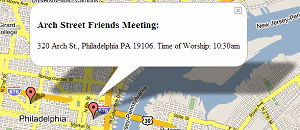 To the best of my knowledge this is the first Quaker Google Maps hack, showing the meetinghouses of downtown Philadelphia. Click on the thumbtacks for details; click on the satellite view for a cool view! Like much of the web it looks much better in “Firefox”:http://www.mozilla.org/products/firefox/. Hack courtesy of the extremely experimental “MyGmaps”:http://mygmaps.com, data from “Quakerfinder.org”:www.Quakerfinder.org. Here’s my short list of “Google Map Hacks”:http://del.icio.us/martin_kelley/map.
Although I love Quakerfinder, it should be noted that Google does almost as good a job listing area “Friends Meetings” via their “local search” feature.
Let Your Lives Speak
April 20, 2005
In the bookstore today a customer called in and asked about “Let your lives speak,” a phrase frequently attributed to George Fox (it’s the source of a book title, “Lives that Speak”). While a quick Google search finds lots of pages where people say things like “as George Fox said, you should ‘let your lives speak,’” no one actually gives details of when and where he said it. The phrase seems to sit only by itself, with no passages before or after it. A few sites claim it was part of his message on Firbank Fell but no one cites a source. Sitting on the same Palm Pilot as the Yardbirds MP3s is Fox’s Journal (Jones edition) and a keyword search doesn’t pick up “lives that speak” or “let your lives speak” anywhere. Smells fishy, like another one of those too-good-to-be-true Fox quotes. Can anyone document that it’s real?
PS: I fly bright and early tomorrow morning for this year’s Quakers Uniting in Publications meeting, in Oregon. I don’t know what internet access I’ll have so my apologies if new comments have to sit for a few days.
Selling Quakerism to The Kids
November 23, 2004
A few weeks ago I got a bulk email from a prominent sixty-something Friend, who wrote that a programmed New Age practice popular in our branch of Quakerism over the last few years has been a “crucial spiritual experience for a great many of the best of our young adult Friends to whom [Liberal Friends] must look for its future” and that they represented the “rising generation of dedicated young adult Friends.” Really? I thought I’d share a sampling of emails and posts I’ve gotten over just the last couple of days.
Vanity Googling of Causes
October 2, 2004
A poster to an obscure discussion board recently described typing a particular search phrase into Google and finding nothing but bad information. Reproducing the search I determined two things: 1) that my site topped the list and 2) that the results were actually quite accurate. I’ve been hearing an increasing number of stories like this. “Cause Googling,” a variation on “vanity googling,” is suddenly becoming quite popular. But the interesting thing is that these new searchers don’t actually seem curious about the results. Has Google become our new proof text?